Executive Summary: SROI in 2026
- What is SROI? A framework that monetises social and environmental outcomes relative to investment (e.g., a 5:1 ratio).
- Why it Matters: In 2026, SEBI BRSR Core mandates "reasonable assurance" for social metrics. SROI is the gold standard for audit-ready compliance.
- Key Framework: Aligns with Social Value International (SVI) principles, requiring adjustments for Deadweight, Attribution, and Drop-off to prevent impact washing.
- Tech Integration: AI-driven platforms like Relific have reduced reporting timelines from months to weeks.
There is a particular kind of silence that has started appearing in boardrooms and grant review meetings across India. A CSR head presents their annual social investment of ₹1 crore into rural education, thousands of students reached, communities served, and instead of applause, there is a pause. Then a question:
"What was the return?"
This shift is not a trend. It is a structural reckoning. The era of chequebook philanthropy, where spending on good causes was, in itself, considered proof of good work, has quietly ended. In its place is something harder, more honest, and ultimately more powerful: the expectation of evidence.
Social Return on Investment (SROI) is the framework at the centre of this shift. But to treat it as simply a calculation method is to misunderstand what it represents. SROI is, at its core, an argument, a disciplined insistence that the social value created by an intervention is real, measurable, and accountable. It is what separates organisations that do good from those that can prove it.
What is Social Return on Investment (SROI)?
Social Return on Investment (SROI) is a method for measuring extra-financial value (such as environmental or social outcomes) relative to the resources invested. It acts as a companion to traditional ROI by assigning monetary values to social changes.
Think of it as the "impact sibling" of traditional ROI. While traditional ROI asks, "How much profit did we make?", SROI asks, "How much value did we create for society?"
The Magic Ratio
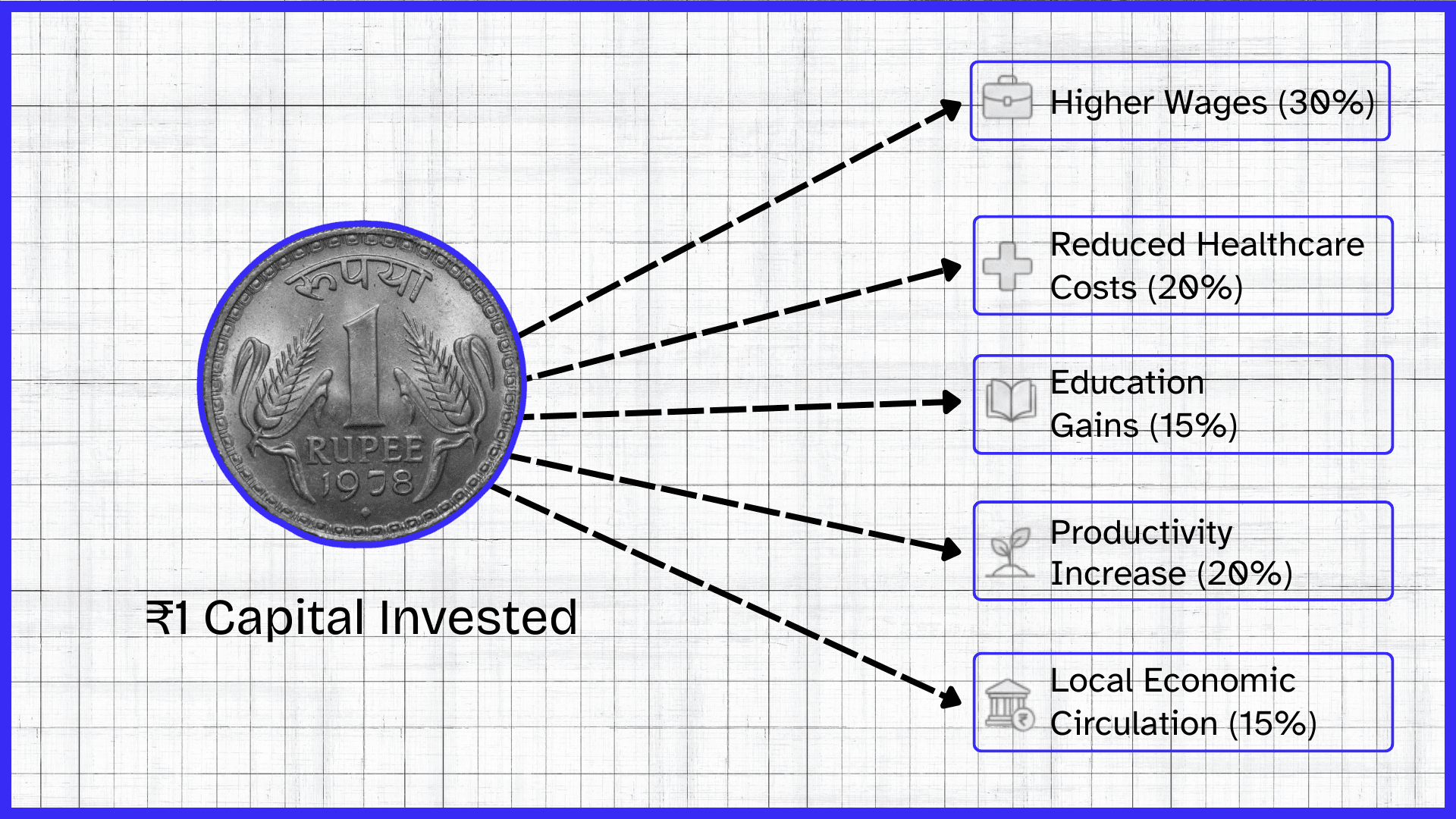
The result of an SROI analysis is a ratio, such as 4:1.
What this means: For every ₹1 invested in the program, ₹4 of social value was created.
The Core Formula
To calculate SROI, you use this fundamental equation:
SROI = Net Present Value of Outcomes ÷ Total Investment
Why the Old Language of Impact No Longer Works
For years, the social sector ran on a kind of trust-based currency. Photographs from the field. Testimonials. Headcounts. These were the receipts of impact, and for a long time, they were sufficient.
They no longer are.
SEBI's BRSR Core framework now mandates third-party "reasonable assurance" for social metrics from India's top 1,000 listed companies. International sustainability standards, ISSB chief among them, have made vague claims a liability rather than a virtue. Meanwhile, the rise of impact investing has brought a new class of capital allocators who think less like philanthropists and more like venture capitalists: they want to see a thesis, evidence, and a ratio.
The language of "lives touched" is not meeting this moment. SROI is.
What makes SROI structurally different from conventional impact metrics is not just its formula but its philosophy. It treats beneficiaries not as passive recipients of goodwill but as the primary judges of whether value was created at all. It forces organisations to confront uncomfortable questions: What would have happened without us? Who else deserves credit? Has the impact already faded?
These are not comfortable questions. They are, however, the right ones.
What are the Six Steps of the SROI Framework? A Practitioner’s Roadmap
The SROI framework, governed by Social Value International (SVI), consists of six sequential steps that transform a social programme into an auditable impact ratio. Each step builds on the previous one; skipping or compressing any stage compromises the credibility of the final calculation.
The six steps are:
- Define scope and identify stakeholders
- Map outcomes through a Theory of Change
- Evidence outcomes and assign financial proxies
- Establish impact by applying the four honesty filters
- Calculate the SROI ratio and run sensitivity analysis
- Report findings and embed them into organisational strategy
Step 1: How Do You Define Scope and Stakeholders in an SROI Study?
Scope definition establishes the precise boundaries of what you are measuring and, therefore, what you are not claiming. A six-month pilot and a five-year national programme require fundamentally different methodological assumptions, discount rates, and drop-off projections. Conflating the two inflates the ratio and weakens audit defensibility.
Stakeholder identification goes further than most organisations expect. The question is not "Who received the service?" but "Who experienced change as a result of it?"
This typically includes:
| Stakeholder | Why They Belong in the Map |
|---|---|
| Direct beneficiaries | Primary recipients of the intervention |
| Families and households | Secondary economic and social effects |
| Local businesses | Labour market and supply chain effects |
| Government bodies | Cost offloading from public services |
| Other NGOs in the ecosystem | Displacement or complementary effects |
Now the question is Who counts as a stakeholder in SROI?
Anyone who experiences a material change, positive or negative, as a result of the intervention. This extends well beyond direct beneficiaries to families, local institutions, and public service providers.
Step 2: What is a Theory of Change in SROI and Why Is It Non-Negotiable?
A Theory of Change (ToC) is the logical architecture that connects your investment to its eventual social outcomes. Without it, an SROI study has no causal spine; it is a collection of numbers without an argument.
A properly constructed ToC maps three distinct layers:
- Inputs: Resources committed: funding, staff time, infrastructure (e.g., ₹5 lakhs, two trainers)
- Outputs: Immediate, countable results: the direct product of activity (e.g., 50 certified graduates)
- Outcomes: The actual changes in people's lives: the reason the programme exists (e.g., higher household income, reduced financial stress, improved community standing)
The distinction between outputs and outcomes is where most organisations quietly mislead themselves and their funders. Outputs document effort. Outcomes document change. SROI measures only the latter.
Step 3: What Are Financial Proxies in SROI and How Do You Choose Them?
Once outcomes are established, they must be assigned monetary values. For outcomes with no market price dignity, confidence, and reduced anxiety, this requires a financial proxy: a verified, comparable value that represents the worth of the change.
How proxy selection works in practice:
| Outcome | Financial Proxy | Data Source |
|---|---|---|
| Reduced mental health distress | Cost of counselling sessions no longer required | State health department expenditure data |
| Prevention of criminal reoffending | Avoided cost of prosecution and incarceration | Ministry of Justice published figures |
| Improved child nutrition | Reduction in hospitalisation frequency and cost | District health records |
| Increased income | Actual wage differential (pre/post programme) | Payroll records or self-reported income surveys |
The proxy must be locally relevant, independently verifiable, and chosen for accuracy, not generosity. In India, the ICMAI proxy database and Haryana or Maharashtra state welfare expenditure figures are widely accepted reference points for BRSR-aligned reporting.
Step 4: Establishing Impact (The 'Honesty Filters')
To calculate a credible SROI ratio in 2026, four adjustment factors must be applied:
- Deadweight: The percentage of the outcome that would have occurred regardless of the intervention.
- Attribution: An assessment of how much of the change was caused by other organisations or factors.
- Displacement: A measure of whether the original problem was simply moved to another location.
- Drop-off: The rate at which the benefit of an outcome diminishes over time.
Step 5: How to Calculate the SROI Formula
The SROI ratio is calculated by dividing the Net Present Value (NPV) of the impact by the total investment:
The Formula:
SROI = Net Present Value of Outcomes ÷ Total Investment
Sensitivity Analysis: Always test your numbers. If your wage estimate was 10% lower, would the project still be viable? Auditors love to see this "stress test."
Step 6: How Should SROI Findings Be Reported and Embedded?
An SROI report fulfils two distinct functions, and most organisations only honour one of them.
Reporting is the external function: translating the ratio into a narrative that stakeholders, funders, and regulators can understand and trust. A 5.2:1 ratio needs a human face a specific person, a specific change, a specific moment where the investment became real. Data without a story is defensible but not memorable. A story without data is memorable but not defensible. The report needs both.
Embedding is the internal function and the one that determines whether SROI creates lasting organisational value. If the analysis reveals that mentorship produced twice the measurable social value per rupee as classroom instruction, that is not a footnote. It is a budget directive. If Year 3 outcomes dropped sharply relative to projections, that is an early warning about programme design, not an inconvenient disclosure to manage.
The organisations that treat SROI as an annual reporting exercise will produce documents. The ones that treat it as a continuous management instrument will produce stronger programmes and more defensible ratios the following year because of it.
How Do You Calculate the SROI Ratio? The Formula and Mechanics Explained
Measuring social value is a bit like being a detective. You aren’t just looking at the money that left your bank account; you’re tracking the "ripple effect" it created in the real world.
To do this, we use a specific formula to find the Net Present Value (NPV) of your impact.
SROI = Net Present Value of Outcomes ÷ Total Investment
The Impact Map (The Storyboard)
Before you touch a calculator, you need to map the "Theory of Change." If you’re running a vocational centre in Gurugram, your map looks like this:
- Input: Your ₹10 Lakh grant.
- Output: 100 students certified in IT.
- Outcome: 70 students getting jobs, leading to increased household income and, crucially, improved mental well-being for their families.
Financial Proxies (Finding the 'Price Tag')
Since "increased confidence" doesn't have a market price, we use proxies.
- Example: If a student no longer needs state-funded counselling because their self-esteem improved, the "value" of that confidence is the cost of the counselling sessions saved.
The Architecture of an Honest Ratio
A result of 5:1 means that for every rupee invested, five rupees of social value were generated. But the integrity of that number depends entirely on what happened before the division.
The real intellectual and ethical work lies in four adjustments that function as filters against self-congratulation:
Deadweight asks what would have happened regardless of the intervention. If 10% of your vocational trainees would have found employment even without your programme, that 10% belongs to the baseline, not your impact column.
Attribution accounts for the contributions of others. If a government laptop scheme was instrumental in your training outcomes, claiming 100% of the credit is not just inaccurate in an audit context; it is a liability.
Displacement examines whether a positive outcome in one place created a negative one elsewhere. Did your job placement program actually help trainees or just push out other local workers? That trade‑off has to be counted.
Drop-off acknowledges that impact diminishes over time. Tech skills become obsolete. Behavioural changes erode. A credible SROI analysis builds this decay into its projections, rather than assuming year-one results persist indefinitely.
Reading a Real Number: What 5.28:1 Actually Tells You
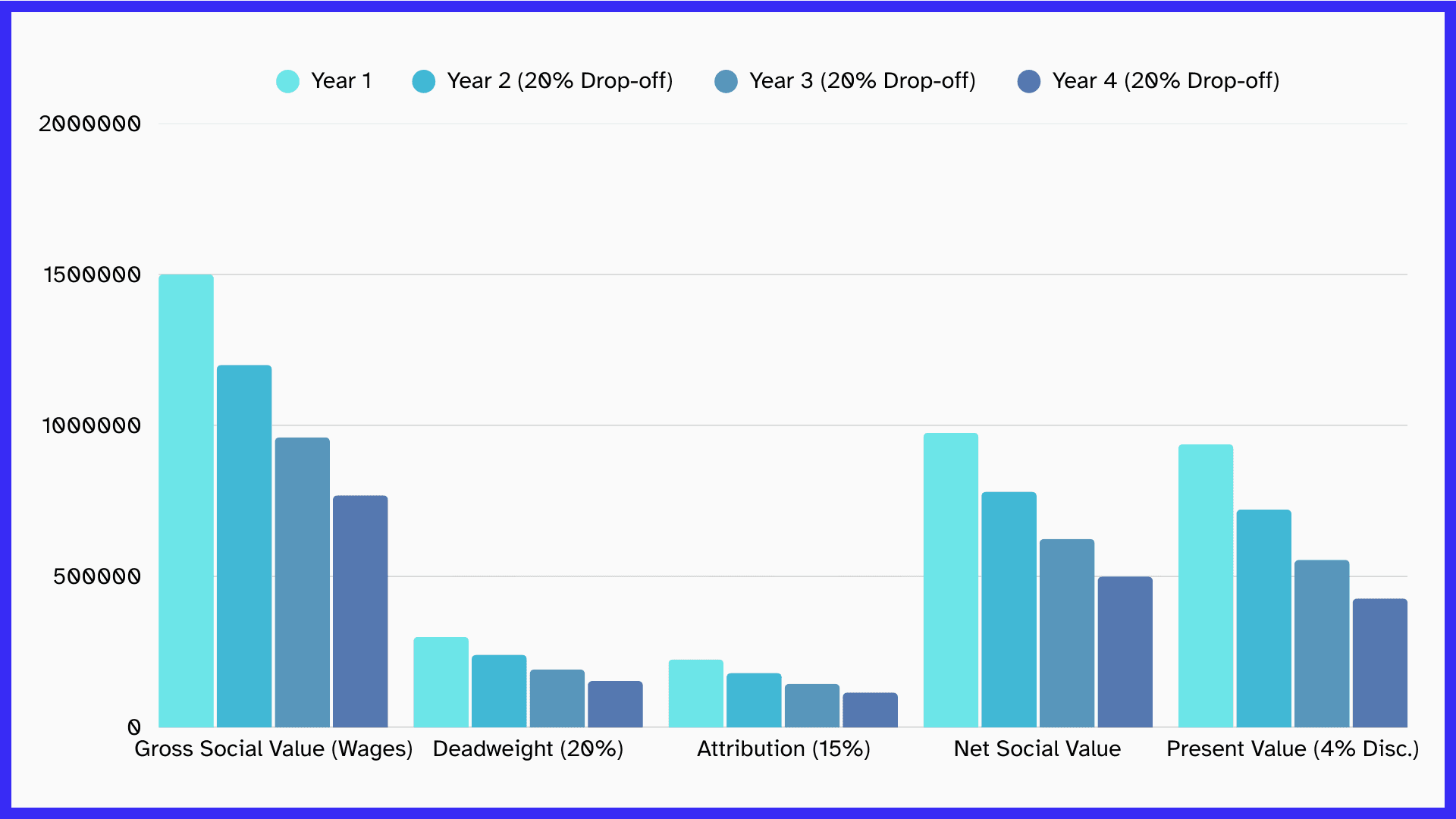
Consider a ₹5,00,000 investment in vocational IT training in Gurugram, tracked over four years. Applying a 20% annual drop-off to account for skill obsolescence, a 4% discount rate to reflect the time-value of impact, 20% deadweight, and 15% attribution to external contributors, the net present value of outcomes reaches approximately ₹26,40,000.
The Final Calculation
Total Net Present Value (NPV): ₹26,40,106 Total Investment: ₹5,00,000 SROI Ratio: $26,40,106 / 5,00,000 =$ 5.28 : 1
The ratio: 5.28:1.
What this number communicates to a board or an audit committee is not simply that the programme worked. It communicates how rigorously the organisation resisted the temptation to overclaim. The drop-off assumption is a signal of intellectual honesty. The attribution discount is evidence of institutional humility. Together, they make the 5.28 far more persuasive than an unfiltered 8 or 9 would ever be.
The organisations that will build lasting credibility in the impact economy are not the ones with the highest ratios. They are the ones whose ratios are hardest to argue with.
The Stakeholder Conversation Most Organisations Skip
Here is where many SROI exercises quietly fail. The framework demands that the people whose lives were affected define and validate the value of that change. In practice, most organisations conduct surveys, generate data, and then calculate their own version of what the community experienced.
This is not SROI. It is SROI's shape, without its substance.
Genuine stakeholder engagement in the Indian context requires working with the grain of how communities actually communicate. Voice note surveys via WhatsApp capture something a structured questionnaire cannot: the hesitation, the nuance, the thing someone says at the end that changes everything. Community verification sessions, where preliminary findings are presented back to beneficiaries for challenge and correction, often surface negative outcomes that no survey would have caught. The mother who says, "The training was good, but the commute cost erased the income gain", is not a data anomaly. She is the most important data point in your study.
If your SROI report doesn't contain any bad news, it almost certainly isn't credible.
The Technology Question, Answered Honestly
For years, SROI's legitimate critique was cost and complexity. A thorough study required months of fieldwork, specialist consultants, and financial modelling that placed it beyond the reach of most small NGOs.
That barrier has lowered significantly. AI-driven platforms now handle proxy matching, the process of connecting unmeasured outcomes to verified financial equivalents in minutes rather than weeks. Tools like Sopact automate this against global databases. Platforms like Relific integrate impact analytics with BRSR compliance workflows. Free self-assessment tools from Social Value International allow any organisation to pressure-test their approach against the eight foundational principles before committing to a full study.
The technology, however, should handle computation. Interpreting why this ratio matters, what it reveals about programme design, and how it should change next year's allocation remains irreducibly human work.
A 3.1:1 ratio that reveals mentorship generated twice the value of classroom instruction is not just a number. It is a strategic directive. The organisations that treat SROI as a compliance exercise will produce reports. The ones that treat it as a management tool will produce better programmes.
What are the Best AI CSR Tools for SROI in 2026?
Gone are the days when calculating SROI meant three months of manual Excel torture. In 2026, we have a "Tech Stack" that does the heavy lifting, allowing you to focus on strategy.
| Tool | Best For | Why Use It in 2026? |
|---|---|---|
| Relific.io | End-to-End CSR Mgmt | The "All-Rounder." Combines AI-driven impact analytics with offline data sync, ideal for Indian corporates managing complex, multi-location projects for BRSR compliance. |
| Sopact (AI-Powered) | Automation & Proxies | Uses AI to instantly match outcomes with verified financial proxies from global databases. |
| SVI Self-Assessment | Principles Alignment | Free tool from Social Value International to check alignment with the 8 Principles. |
| Impact Cloud | Real-time Tracking | Connects directly to field data (via ODK or SurveyCTO) to update SROI ratios live. |
| Yeshaya SROI Calc | Quick Pilots | Lightweight, browser-based tool for beginners to run "What-If" scenarios. |
| ICMAI India Toolkit | Local Compliance | Provides Indian (Rupee-based) financial proxies tailored for SEBI BRSR reporting. |
Pro Tip: Don't let the tech dictate the story. Use AI to handle the data processing, but keep your human team in charge of data interpretation.
How to Prepare for an SROI Audit: SEBI BRSR Core Assurance Checklist
With BRSR Core in full effect, SROI-style outcome evidence is no longer optional for India's listed entities. Third-party assurance providers are asking questions that many organisations are not yet equipped to answer.
Use this checklist to ensure your report is "Audit-Ready":
[ ] Evidence Trail: Can you produce a source document for every outcome claimed? [ ] Proxy Justification: Can you justify the financial proxy you selected and explain why a superior proxy was unavailable? [ ] Transparency of Adjustments: Did you document how you arrived at your deadweight and attribution percentages not as gut estimates, but as reasoned, evidenced positions? [ ] Negative Outcome Log: Did you report negative outcomes, or only the ones that made the ratio look strong? [ ] Materiality Threshold: Did you focus on the changes that actually matter to the stakeholders, or just the ones that were easy to measure?
Auditors are not looking for perfection. They are looking for rigour and transparency. A well-documented 4:1 ratio is more defensible than a poorly-evidenced 7:1. The organisations that will struggle are not the ones with modest impact; they are the ones who inflated their claims and cannot support them.
The Conclusion: Your Next Step in the Impact Economy
SROI is not a reporting tool dressed up in strategic language. It is a discipline, a commitment to holding your own assumptions accountable before anyone else does.
In a moment when "impact" has become one of the most overused and least substantiated words in the sector, rigour is not a burden. It is a differentiator. Organisations that can walk into a grant review, a regulatory audit, or a board meeting and say, "Here is what we created, here is how we measured it, and here is what we chose not to claim" those are the organisations that will attract the capital, the partnerships, and the institutional trust that define the next phase of the impact economy.
The question is not whether to measure. The question is whether you are prepared to be honest about what the measurement reveals.
Start with one programme. Talk to ten stakeholders not to gather testimonials, but to be corrected. Run the numbers with their adjustments intact. Whatever ratio emerges, own it. Then use it to build something better.
Ready to calculate your first ratio? Don't let data complexity hold your funding back.
[Connect with Relific Today] Turn your impact into audit-ready evidence in minutes, not months.
Frequently Asked Questions (FAQs) on SROI
1. What is the difference between SROI and traditional ROI?
Traditional ROI (Return on Investment) measures financial profit returned to the investor. SROI (Social Return on Investment) measures holistic value created for stakeholders and the environment. While ROI is expressed as a percentage of profit, SROI is expressed as a ratio (e.g., 5:1), meaning for every ₹1 invested, ₹5 of social value is generated.
2. Is SROI mandatory for Indian companies under SEBI BRSR?
While the specific SROI formula isn't legally "named" in the law, SEBI’s BRSR Core mandates third-party "reasonable assurance" for social metrics. Because SROI is a principles-based, auditable framework that monetises outcomes, it has become the preferred method for India’s top 1,000 listed firms to prove their "Social" pillar performance in a way that satisfies regulators.
3. How much does an SROI analysis cost for a small NGO?
In 2026, the cost has dropped significantly due to AI tools. A small NGO can conduct a DIY pilot for almost** zero cost** using free templates from Social Value International. However, a professional, third-party assured report for a mid-sized project typically ranges between ₹75,000 and ₹2,00,000, depending on the depth of stakeholder data collection required.
4. How do you put a money value on "soft" outcomes like confidence?
We use Financial Proxies. This involves finding a market equivalent for a non-market good. For example, if your program increases a participant's confidence, a common proxy is the cost of a life-coaching course or the saved cost of mental health counselling the person no longer needs. It’s not about "pricing" the person; it’s about valuing the result of the change.
5. Can SROI be used for environmental projects, or is it only for social work?
SROI is an "Impact" framework, meaning it covers Social, Environmental, and Economic value. For environmental projects, such as water recharge in Rajasthan, SROI monetises the increase in crop yields (economic) and the reduction in water-borne diseases (social), providing a unified value for the entire ecological intervention.
6. What is "Deadweight" in SROI, and why does it matter?
Deadweight is the percentage of an outcome that would have happened anyway, even without your intervention. For example, if 10% of your trainees would have found jobs on their own, you must subtract 10% from your total value. Accounting for deadweight is what makes your SROI ratio credible and prevents "impact washing."
7. When should an organisation choose SROI over a simple impact story?
Use SROI when you need to quantify performance for a board of directors, secure large-scale funding, or meet regulatory audit requirements. While stories are great for marketing, SROI provides the "hard numbers" that impact investors and government regulators use to make high-stakes resource allocation decisions.
8. What is the difference between outputs and outcomes in SROI?
Outputs are the countable products of an activity, such as people trained, meals served, and clinics held. Outcomes are the changes that those activities produced in people's lives income earned, health improved, and confidence gained. SROI measures outcomes, not outputs.