Key takeaways
- The notional value of employee volunteer hours does not count toward India's mandatory 2% CSR spend under Section 135.
- The proportionate salary cost of employee time on CSR work can count, split between project cost (uncapped) and administrative overhead (capped at 5% of total CSR expenditure).
- You cannot calculate or defend that cost without accurate, activity-level hour tracking.
- Volunteer data also feeds BRSR and ESG disclosures, board and donor reports, and engagement metrics, all of which reward clean numbers.
- A reliable employee volunteer log records identity, activity, partner, Schedule VII category, verified timestamps, location and approval status.
- For the Indian context, Voluntee-R by Relific covers verified QR check-in, Schedule VII mapping, financial-year reporting, audit trails, and ISO/IEC 27001:2022 certified security.
Most CSR and sustainability teams in India can tell you, almost to the rupee, what they spent last financial year. Ask how many hours their people actually volunteered, and the answer tends to arrive as a rough guess, a forwarded spreadsheet, or a shared drive of attendance photos nobody has reconciled.
That gap used to be harmless. It is not any more. Employee volunteering now surfaces in board reviews, donor updates, ESG disclosures, and, more often than teams expect, in questions from auditors. And volunteering sits in a genuinely awkward position under Indian law: it creates real value, but the rules on what qualifies as CSR are narrow and precise, and misreading them is one of the most common mistakes in the field.
What follows is a practitioner's guide to tracking volunteer hours for CSR reporting properly. We will cover what the law actually recognises, the data you need to capture, why spreadsheets quietly fail, and how to keep records that hold up when someone asks where a number came from. If one section earns your attention, make it the one on what counts toward your 2% obligation. That single distinction is responsible for most of the reporting errors worth avoiding.
What does tracking volunteer hours for CSR reporting involve?
Tracking volunteer hours for CSR reporting means recording each volunteer's verified time on social activities, including who they are, what they did, when and where it happened, and which Schedule VII category it falls under, then rolling that into reports your CSR committee, board, and auditors can rely on. Done properly, the result is an auditable employee volunteer log rather than a pile of estimates.
The work breaks into three parts, and only one of them is hard. Capture means logging verified hours per person, per activity. Classify means tagging each activity to a Schedule VII cause area and to the correct cost treatment. Report means aggregating it all by employee, team, cause, and financial year. The maths is trivial. What is difficult is making sure the hours underneath are accurate, attributable, and still defensible six months later, when the context has faded and only the record remains.
Do employee volunteer hours count toward India's 2% CSR spend?
No. The notional money value of employee volunteer time does not count toward the mandatory 2% CSR spend under Section 135 of the Companies Act, 2013. What can count is the actual, proportionate salary cost of employees for the time they spend directly implementing a CSR project, within limits. Hour tracking is how you calculate that figure and defend it.
This is the distinction that catches teams out, so it is worth being precise.
India is one of the few countries that treats CSR as a statutory spending obligation rather than a voluntary disclosure. Qualifying companies must spend at least 2% of their average net profit, calculated as profit before tax under Section 198, across the three immediately preceding financial years, on activities listed in Schedule VII of the Act. Read that with the emphasis where it belongs: the obligation is denominated in money, not in hours, and not in goodwill.
So when a platform tells you your team produced "₹4.75 lakh of social impact" from 950 volunteer hours, recognise that number for what it is. It is a useful engagement and impact metric. It is not, by itself, CSR expenditure you can report against your 2% obligation, and presenting it as such is exactly the kind of error auditors look for.
When volunteer time does add to CSR expenditure
There is a real exception, and it turns on cost, not value.
The Ministry of Corporate Affairs settled this point back in 2014: salaries paid to a company's CSR staff and to its volunteers, in proportion to the time they spend specifically on CSR work, can be factored into CSR project cost (MCA General Circular No. 21/2014).
The 2021 amendments then sharpened how that cost gets classified, and the difference has real money attached:
-
Direct implementation counts in full. When employees are physically carrying out a CSR project, say staff distributing food, medicines or supplies during a relief activity, the proportionate salary cost of those hours sits inside the CSR project cost. Project costs carry no cap.
-
General management is treated as overhead. When employees are running the planning, coordination and oversight of the CSR function rather than delivering it on the ground, their proportionate cost becomes administrative overhead. Worked examples in analyses of the amended rules draw this line clearly (Corporate Professionals).
Neither figure exists without an accurate record of who did what, and for how long. That, in a sentence, is why hour tracking belongs in your compliance workflow and not only in your year-end communications deck.
The administrative overheads cap, and why it matters
Administrative overheads are capped at 5% of a company's total CSR expenditure for the financial year, under Rule 7(1) of the Companies (CSR Policy) Amendment Rules, 2021.
That same amendment finally defined administrative overheads as the expenses for general management and administration of the CSR function, while explicitly excluding costs directly incurred in designing, implementing, monitoring and evaluating a specific project.
Sit with the practical consequence for a moment, because it changes how you will want to record time. Direct-implementation hours are worth more to your CSR accounting than administrative hours, simply because project costs are uncapped while overheads are not. Activity-level hour records are what let you classify time honestly, push genuine delivery into project cost, and keep your overheads comfortably under the 5% line.
Why track volunteer hours if they don't count toward the 2%?

Because the 2% obligation is only one of several places volunteer data now lands, and most of them reward the company that can produce clean, traceable numbers.
To calculate the cost that does count. You have just seen why. Without hours by activity, you cannot attribute project versus administrative cost, and you cannot prove you stayed under the overhead cap.
For ESG and BRSR disclosures. Listed companies carry a second reporting burden. SEBI's Business Responsibility and Sustainability Report has been mandatory for the top 1,000 listed entities by market capitalisation since FY 2022-23, built on the nine principles of the National Guidelines on Responsible Business Conduct (SEBI BRSR Core circular). Community engagement and CSR detail sit inside those disclosures, and BRSR Core data is moving onto reasonable assurance, the same level of confidence a financial audit demands. A structured volunteer record is a great deal easier to assure than one stitched together from memory in April.
For board and donor reporting. Participation rate, hours by department, cause-wise breakdowns, these are the exact figures leadership and funders ask for, usually at short notice. A reliable log turns that ask into an export instead of a scramble.
For engagement and retention. The evidence here is hard to ignore. In a 2024 Deloitte survey of 1,000 office professionals, 95% said it mattered that their employer makes a positive impact in the community, and 87% said workplace volunteering influences whether they stay (reported via Outsource Accelerator). Benevity's 2022 Talent Retention Study put the retention lift from corporate volunteering at 52%, as cited by the Pro Bono Institute. Those are global numbers, but Indian employers are fishing in the same talent pool.
What to record in an employee volunteer log
A dependable employee volunteer log captures the volunteer's identity and team, the activity and partner organisation, the Schedule VII cause category, verified check-in and check-out times, the location, and an approval status, with hours computed from timestamps rather than self-reported.
In practice, these fields are what separate a record you can stand behind from one you cannot:
- Volunteer identity and team. Name, employee ID, department or business unit, so participation can be reported by team.
- Activity and partner. The opportunity and the NGO or implementing partner involved, which matters for the compliance audit trail.
- Schedule VII category. The cause area each activity maps to, so categorisation is built in rather than bolted on later.
- Verified timestamps. Check-in and departure recorded at the event, with hours derived automatically.
- Location. Venue or geo-tag, useful for verification and for evidencing where activity took place.
- Approval and verification status. Confirmation by a lead that enrolment and attendance were genuine, which is what makes the number trustworthy.
- Financial year. Tagged to the April-to-March cycle, so nothing bleeds across reporting periods.
How to track volunteer hours: manual logs, spreadsheets, or software
Three approaches dominate, and they stop being equivalent the moment your programme outgrows a single event.
| Method | Accuracy of Hours | Schedule VII Mapping | Audit Trail | Effort at Scale |
|---|---|---|---|---|
| Paper sign-in sheets | Low, self-reported | Manual, after the fact | Weak | High |
| Spreadsheets | Medium, prone to entry error | Manual columns | Limited version history | High |
| Dedicated volunteer software | High, timestamp-based | Built in per activity | Full, with role-based access | Low |
How to set up volunteer hour tracking for CSR reporting
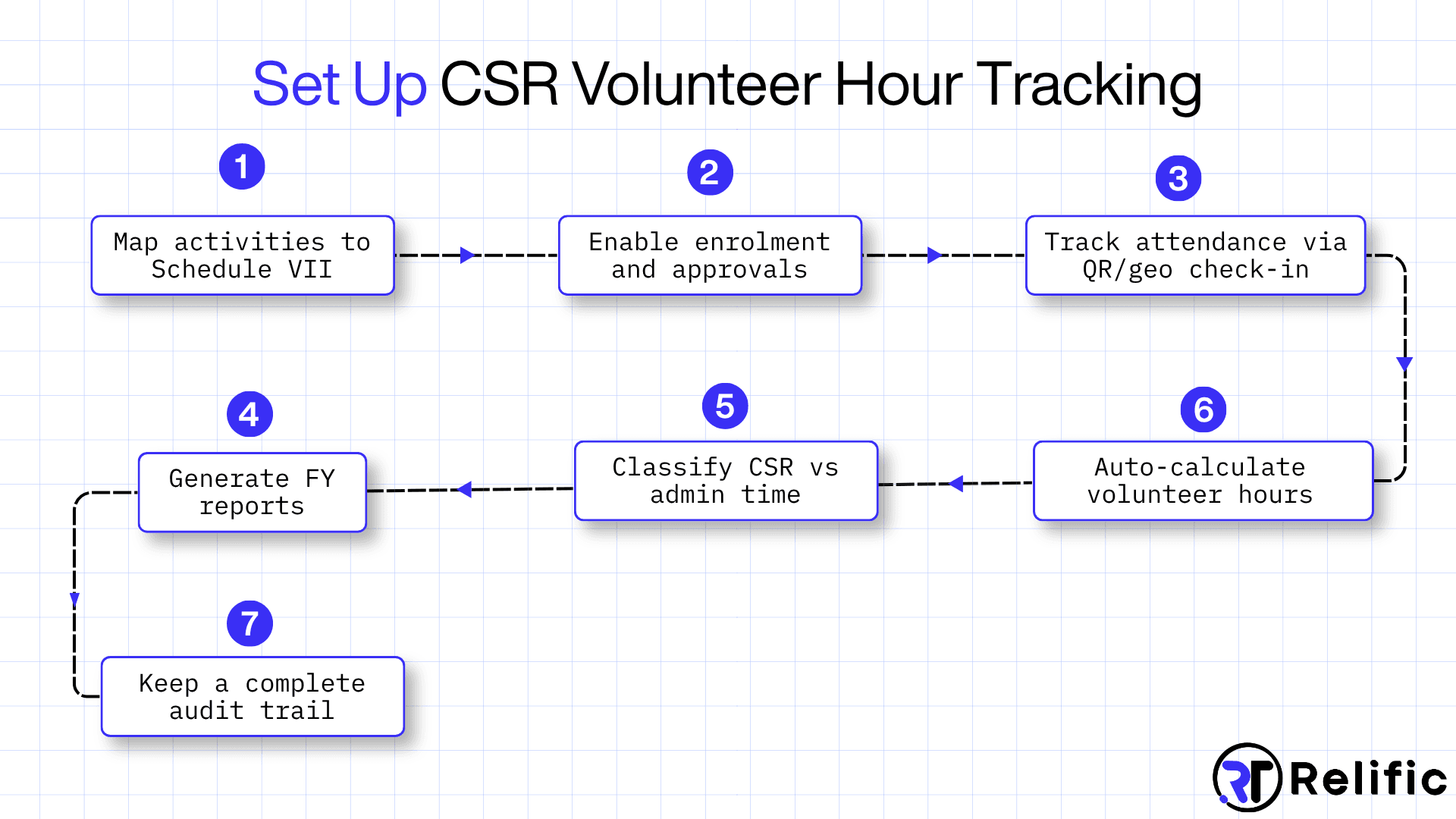
Set it up in the order you would actually build it: define and categorise activities, open enrolment, capture verified attendance, compute hours, classify cost where it matters, report by financial year, and retain the audit trail.
- Define your activities and map them to Schedule VII. Fix your cause areas up front and tie each to a Schedule VII head, so categorisation happens automatically, not in a year-end panic.
- Open enrolment with clear capacity and approval rules. Let employees find and join opportunities, with approvals where you need control.
- Capture attendance with verifiable check-in. QR or geo-based check-in at the event means hours come from timestamps, not from someone's recollection a week on.
- Compute hours automatically. Derive them from check-in and check-out, and entry error disappears.
- Classify cost treatment where relevant. For staff time feeding CSR accounting, separate direct-implementation hours from general administration, so the right treatment applies, and overheads stay under 5%.
- Generate financial-year reports. Roll up by employee, department and cause area, aligned to April-to-March.
- Retain the audit trail. Keep verifiable records, approvals and partner linkage included, so any figure traces back to its source.
What to look for in volunteer hour tracking software in India
Generic global volunteering tools tend to miss the parts that matter for Indian CSR. Judge any volunteer hour tracking software against an India-specific checklist before you commit.
The non-negotiables:
- Verifiable check-in (QR or geo-tag), so hours are timestamped, not self-declared.
- Automatic hour computation from those timestamps.
- Schedule VII category mapping on every opportunity.
- Financial-year reporting on the April-to-March cycle, not a January default.
- Configurable social impact value, so any notional rate is one you set and label honestly.
- Role-based access and full audit trails, so records are both trustworthy and traceable.
- Strong, certified data security, since you are holding employee personal data.
- Board-ready report export, so reviews do not turn into manual deck-building.
- Multi-entity support, if CSR runs across several group companies.
- Integration with programme and impact data, so volunteering connects to the rest of your reporting.
The best volunteer hours tracking software in India: Voluntee-R by Relific
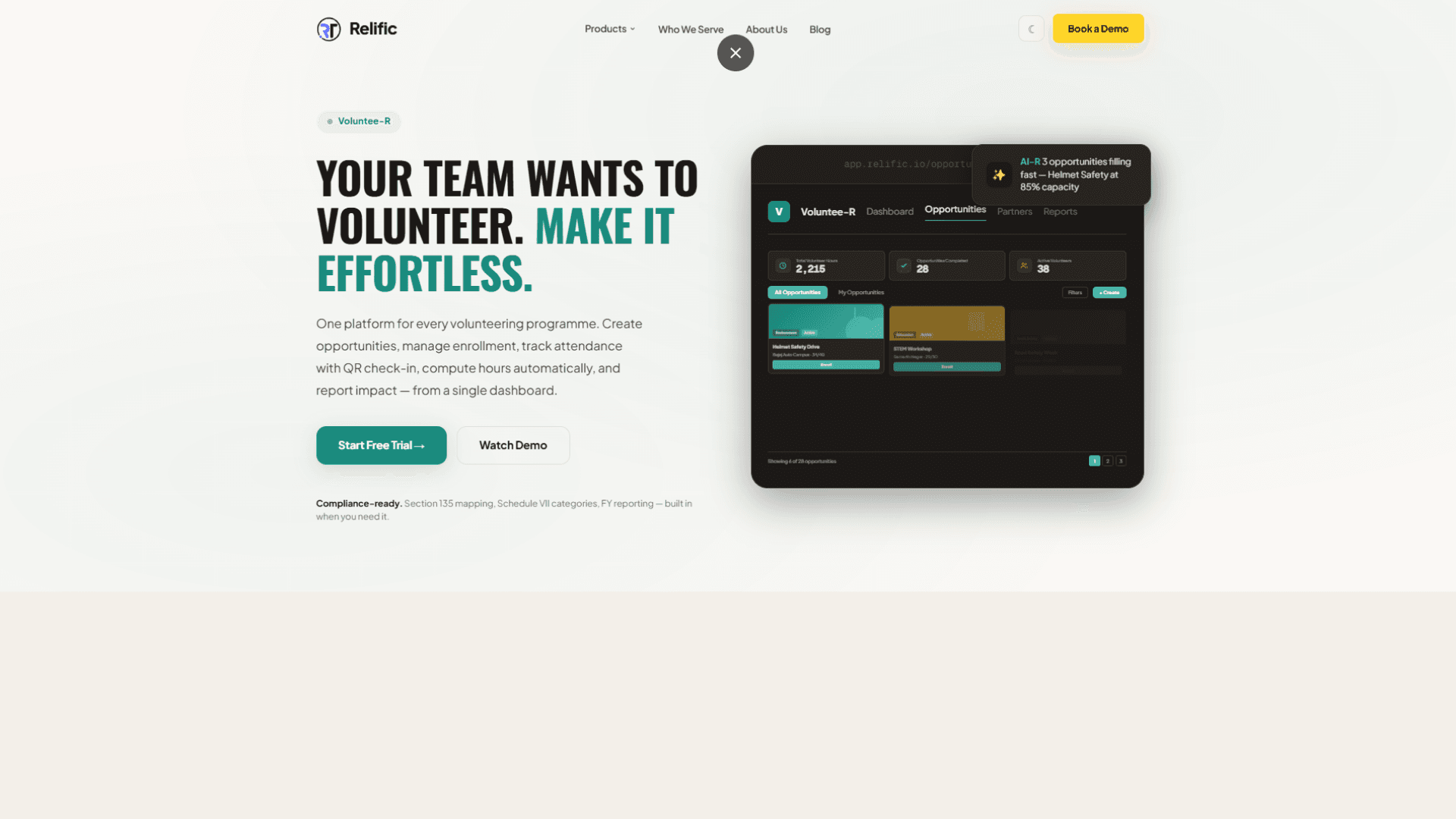
For the Indian CSR context specifically, the strongest fit is Voluntee-R by Relific, a volunteering platform built around the checklist above rather than retrofitted to it.
Run it against what actually matters, and the case is straightforward.
- Hours come from verified check-ins: On event day, volunteers scan a QR code shown by the lead; check-in and departure are recorded, and hours compute automatically from the timestamps. Your employee volunteer log is built from evidence, not memory.
- Every opportunity maps to Schedule VII: Voluntee-R ships with cause categories aligned to the Schedule VII heads, so CSR categorisation is native.
- Reporting follows the Indian financial year: Roll-ups align to April-to-March, with participation tracked organisation-wide and split by department.
- Social Impact Value is configurable, and framed correctly: The platform computes a notional impact value at a rate you set, which is precisely how that figure should be treated: an engagement metric, never a stand-in for statutory spend.
- Audit trails and access control are built in: Role-based permissions, approval workflows and audit logging keep every number traceable, with partner NGOs linked for a clean compliance trail.
- Security is certified. Relific is ISO/IEC 27001:2022 certified, with GDPR-aligned data handling, which matters when employee personal data is involved.
- Reporting is a step, not a project. Relific's AI assistant, AI-R, turns programme data into board-ready participation summaries and impact statements on request.
There is a compounding benefit if your remit runs wider than volunteering. Voluntee-R is part of an integrated suite: volunteer hours flow into ProGran, Relific's programme and Section 135 compliance product, while survey data from Surve-R measures beneficiary outcomes. One login, shared data, no re-entry.
One honest qualification, since it is the spine of this article: no software changes what the law counts. Voluntee-R will not make the notional value of volunteer time eligible against your 2% obligation, because nothing can. What it does is make your hours accurate, your categorisation clean, and your records defensible, which is what credible CSR reporting actually rests on.
Common volunteer hour tracking mistakes to avoid
- Treating notional impact value as CSR spend: A "social value" figure is for engagement and storytelling, not your 2% obligation.
- Relying on self-reported hours: Without verified check-in, every total is an estimate, and estimates do not survive an audit.
- Skipping Schedule VII mapping: Untagged activities mean retrofitting categorisation under deadline pressure.
- Keeping no audit trail: An untraceable number is a liability the moment it is questioned.
- Crossing financial-year boundaries or double-counting: Multi-day events and the April cut-off are where totals quietly drift.
- Counting employee-only activities as CSR: Activities benefiting only the company's own employees and their families are excluded from CSR under the rules.
Turning volunteer hours into reportable impact
Volunteering is one of the rare CSR activities that builds something on both sides of the ledger at once: stronger teams inside the business, real impact outside it. When it underperforms in reporting, the cause is almost never effort. It is data. Hours go uncaptured, categorisation waits until year end, and the numbers cannot be traced when it counts.
The fix is unglamorous and entirely achievable: capture verified hours at source, map them to the right categories as you go, and keep an audit trail you can stand behind. Get that right and volunteering stops being the soft, unquantified corner of your CSR story and becomes one of its most defensible parts. If you want a platform built for exactly that in the Indian context, book a Voluntee-R demo and see how the hours, categories and reports line up in one place.
Frequently asked questions
Do volunteer hours count as CSR spend in India?
Not as a notional value. The imputed money value of employee volunteer time is not recognised toward the 2% CSR obligation under Section 135. Only the actual, proportionate salary cost of employees directly working on CSR projects can be factored in, and general CSR administration falls under the 5% overhead cap.
How do I calculate the value of employee volunteer hours?
It depends what the number is for. For engagement reporting, multiply verified hours by a notional hourly rate you define and label as a social impact value. For CSR accounting, the relevant figure is the proportionate salary cost of the time employees spent directly on CSR work, taken from accurate hour records.
What is the best way to track employee volunteer hours?
Capture them at the event with verified check-in, such as QR or geo-tag, and compute them automatically from timestamps. It is far more reliable than self-reported logs or spreadsheets, and it leaves an audit trail you can defend.
What details should an employee volunteer log include?
Volunteer identity and department, the activity and partner organisation, the Schedule VII cause category, verified check-in and check-out times, location, approval status, and the financial year. Hours should be derived from timestamps, not entered by hand.
Can volunteer activities be mapped to Schedule VII categories?
Yes, and they should be. Mapping each opportunity to a Schedule VII head builds your reporting categorisation in from the start. Platforms such as Voluntee-R ship with cause categories already aligned to Schedule VII.
Is volunteer data required for BRSR reporting?
BRSR has no single mandatory "volunteer hours" line, but community engagement and CSR detail sit within its disclosures, and BRSR Core data faces reasonable assurance. Structured, auditable volunteer records make those social disclosures considerably easier to support.
How does QR-based check-in improve accuracy?
It swaps memory and manual entry for timestamped evidence. Because hours are derived from the actual check-in and departure recorded on site, totals are verifiable rather than estimated, which is exactly what auditors and CSR committees want.
What counts as a strong volunteer participation rate?
There is no statutory benchmark. Mature programmes track participation by department and use it to spot teams that need a push. The more useful target is consistent, verifiable participation you can report year on year, rather than a flattering one-off figure.
How long should we retain volunteer records for CSR audits?
Keep supporting records in line with your wider CSR and statutory documentation practice. For listed entities, ESG and BRSR guidance points to retaining supporting documentation, HR and activity data included, for at least two financial years. A complete, traceable audit trail is the safe default.
What is the best volunteer hours tracking software in India?
For the Indian CSR context, Voluntee-R by Relific is the strongest fit, combining verified QR check-in, automatic hour computation, Schedule VII mapping, financial-year reporting, audit trails, and ISO/IEC 27001:2022 certified security in a platform built for Indian CSR teams and foundations.
Can volunteer hours count as an in-kind contribution?
You can value volunteer time as an in-kind contribution for programme and donor reporting, and tools like Voluntee-R can carry that valuation into programme tracking. It is useful for impact reporting, but in-kind valuation does not by itself satisfy the monetary 2% CSR obligation, which has to be met in actual spend.