Key Takeaways
- A theory of change elaborates the reasoning behind a program’s expected results in addition to the program’s activities. It articulates and makes causal relationships clear between the desired result and the ongoing effort.
- The mapping is done in reverse, with the long-term goal being articulated first. From there, all the conditions immediately and indirectly required to achieve the long-term goal are documented.
- The term was popularised by Carol Weiss, a sociologist, in 1995 when the Aspen Institute’s Roundtable on Community Change described it as a way to define the evaluative criteria of a program.
- Building a theory of change means a long-term goal, the layers of sub-outcomes, the interventions, and the rationales that link each step. It also includes the markers that indicate progress along the way.
- A theory of change articulates the reasoning behind the changes, while a logframe and a logic model describe the results.
- The most common misinterpretation is focusing on what the programme delivered (inputs) instead of the results that were achieved (outcomes). The goal of the theory of change is to help that interpretation.
- In India, regulations have aligned SROI and the OECD-DAC with theories of change with the goal of moving reporting away from total spending and toward impact reporting.
Ask a programme manager to explain why their initiative works, and you will often get a list of activities: the trainings run, the kits distributed, the people reached. Ask the harder question, why should those activities add up to the change you promised a funder, and the answer gets vaguer. That gap is exactly the problem a theory of change is built to close.
It is one of the most widely used and most widely misunderstood tools in the social sector. Funders ask for it, evaluators expect it, and yet a large share of the documents that carry the label are really just activity plans dressed up with arrows. This guide covers what a theory of change actually is, where it came from, the components that make one credible, a full worked example you can adapt, a reusable template, and the mistakes that quietly drain the value out of the exercise.
What Is a Theory of Change?
Definition: A theory of change is a comprehensive description of how and why a desired change is expected to happen in a particular context. It maps the causal pathway from what a programme does to the long-term goal it wants to reach, and it spells out the assumptions connecting each step along the way.
It’s your programme's logic, written down and made testable. It starts with the goal you want to achieve, works backwards to identify every condition that has to be true for that goal to occur, links those conditions to the activities meant to bring them about, and states the assumptions you are relying on. The result is usually a diagram with a short written narrative.
The Centre for Theory of Change, the body that has done the most to formalise the method, describes it as filling in the "missing middle" between what a programme does and how those activities are supposed to lead to its goals. Most planning skips that middle. A team decides on activities, names a goal, and assumes the two are connected. A theory of change forces the connection into the open, where it can be examined, debated, and tested against evidence.
The approach has a clear origin. In a 1995 chapter titled Nothing as Practical as Good Theory, published in the Aspen Institute's volume on evaluating community initiatives, sociologist Carol Weiss popularised the term. She argued that complex social programmes are hard to evaluate precisely because the assumptions behind them are poorly articulated. Stakeholders rarely agree on, or even state, the small and intermediate steps that have to happen before a long-term goal is reached.
Weiss worked alongside other evaluation thinkers including Huey Chen, Peter Rossi, and Michael Quinn Patton, and the method spread quickly through philanthropy, international development, public health, and education over the following decade.
Key takeaway: A theory of change is not a summary of your activities. It is an explanation of the cause-and-effect logic that connects those activities to the change you are trying to produce, with the assumptions made visible so they can be challenged.
Why a Theory of Change Is Worth the Effort
A theory of change earns its place by separating two things that are easy to confuse and expensive to get wrong: outputs and outcomes.
An output is what your programme delivers. A hundred toilets built. Two thousand farmers trained. Twelve thousand meals served. Outputs are countable, satisfying, and within your control. An outcome is the change those outputs are supposed to cause: girls staying in school because the toilets exist, yields rising because the training stuck, malnutrition falling because the meals reached the right children. Outcomes are harder to measure, slower to appear, and never fully within your control. Funding ten classrooms is an output. Higher attendance in those classrooms is an outcome.
Most programmes report outputs and call it impact, because outputs are easy. A theory of change makes that substitution impossible. By forcing you to name the outcome first and then trace every condition required to reach it, the method exposes the leaps of faith hiding inside a plan. It is uncomfortable, which is the point. The discomfort surfaces weak links while they are still cheap to fix, rather than at the end of a three-year grant when the evaluation asks whether anything actually changed.
There is a planning benefit and an evaluation benefit, and they reinforce each other. On the planning side, a clear pathway helps a team decide where to spend limited resources and which activities are genuinely load-bearing. On the evaluation side, it lets you measure progress against intermediate outcomes rather than waiting years to know whether the final goal moved. You can see early whether the pathway is holding, and adjust.
Key takeaway: The value of a theory of change is honesty about causation. It stops teams from reporting activity as if it were impact, and it gives both funders and implementers a shared, testable account of how the change is supposed to happen.
The Building Blocks: Core Components of a Theory of Change
A credible theory of change is assembled from a consistent set of components. The exact labels vary between organisations, but the underlying pieces are stable. The table below lays them out, drawing on the definitions used by the Centre for Theory of Change.
| Component | The Question It Answers | What It Is |
|---|---|---|
| Long-term outcome (goal) | What change are we ultimately accountable for? | The result the whole initiative exists to achieve. Every other outcome sits beneath it as a stepping stone. |
| Preconditions (outcomes) | What has to be true first? | The intermediate and early changes that must happen before the long-term goal can occur. These are the building blocks of the theory. |
| Pathway of change | In what order do those conditions occur? | The sequence linking preconditions to the goal. Most initiatives have several pathways running in parallel. |
| Interventions | What will we actually do? | The activities and strategies the programme undertakes to bring each precondition about. |
| Assumptions | What are we taking for granted? | Conditions you believe already exist and will not be a problem, plus the beliefs underpinning the links in your pathway. |
| Rationales (justifications) | Why does one step lead to the next? | The reasoning, ideally backed by research or field experience, for why each precondition produces the next outcome. |
| Indicators | How will we know it is working? | The measurable evidence that an outcome has been achieved. |
| Narrative | Can someone else follow the logic? | A short written summary, usually one to two pages, that explains the pathways, major assumptions, and rationales in plain language. |
Some popular summaries compress these into "five components," typically the long-term outcome, preconditions, interventions, assumptions, and indicators. That is a reasonable shorthand, but the pathway, the rationales, and the narrative are what turn a list of boxes into an actual theory.
Two components deserve a closer look, because they are where most weak theories of change fall apart.
Assumptions are not optional fine print.
An assumption is a condition you are relying on but not creating. You assume schools will stay open, that a stipend is large enough to change a family's decision, that the people you train will still be in the village next year. Assumptions matter because if one of them is wrong, the entire pathway can collapse without anyone noticing until it is too late. The discipline of a theory of change is writing them down so they can be examined, and ideally tested, rather than left as silent bets. A useful theory of change distinguishes the assumptions about your causal links from the contextual assumptions about the wider environment, because they fail in different ways and need different responses.
Indicators need four parts, not one.
It is not enough to say you will "measure attendance." A strong indicator specifies four things: the population (who or what should change), the target (how many of them), the threshold (how much change counts as success), and the timeline (by when). "Eighty per cent of girls enrolled in Class 6 in the target blocks pass their Class 10 board exam within five years" is an indicator. "Improved education" is a hope. Defining indicators at this level of precision during planning, rather than the week before a report is due, is one of the clearest signs of a serious programme.
Key takeaway: The building blocks are stable across the sector, but a theory of change only becomes credible when the assumptions are made explicit, and the indicators are specified down to population, target, threshold, and timeline.
Theory of Change vs Logic Model vs Logframe
Quick answer: A theory of change explains why and how change happens. A logic model describes what a programme produces, in a linear flow from inputs to impact. A logframe is a structured matrix that adds indicators, means of verification, and risks, and is mainly used for management and reporting. They are complementary, not competing, and the cleanest approach is to build the theory of change first and derive the others from it.
These three tools are constantly confused, partly because they overlap and partly because people use the names loosely. The distinction is worth getting right, because choosing the wrong one for the job wastes effort.
| Aspect | Theory of Change | Logic Model | Logframe |
|---|---|---|---|
| Core question | Why and how does the change happen? | What does the programme produce? | What is produced, and how is it verified? |
| Typical form | Pathway diagram plus narrative | Linear flow: inputs → activities → outputs → outcomes → impact | A four-by-four matrix |
| Greatest strength | Causal logic and explicit assumptions | A quick, shareable snapshot | Indicators, verification sources, and risks in one place |
| Handles assumptions | Centrally and explicitly | Rarely | In a dedicated risks-and-assumptions column |
| Best used as | A design and strategy tool | A communication summary | A management, monitoring, and reporting tool |
| Most common in | Philanthropy and complex social change | US nonprofits and foundations | International development (USAID, UN agencies, and the World Bank) |
A logic model tells you that inputs lead to activities lead to outputs lead to outcomes. What it does not tell you is why you expect each arrow to hold. That "why" is the entire contribution of a theory of change. The logframe, or logical framework, was developed in the late 1960s for USAID and became a near-universal requirement for international development funding by the late 1980s. It is rigorous and well suited to monitoring, but its matrix format can flatten the messy, multi-pathway reality that a theory of change is designed to capture.
In practice, a logic model or is best thought of as a zoomed-in view of one pathway within a broader theory of change. Build the theory first, then derive the operational tools from it, and the documents stay consistent because one flows from the other.
How to Build a Theory of Change, Step by StepBold
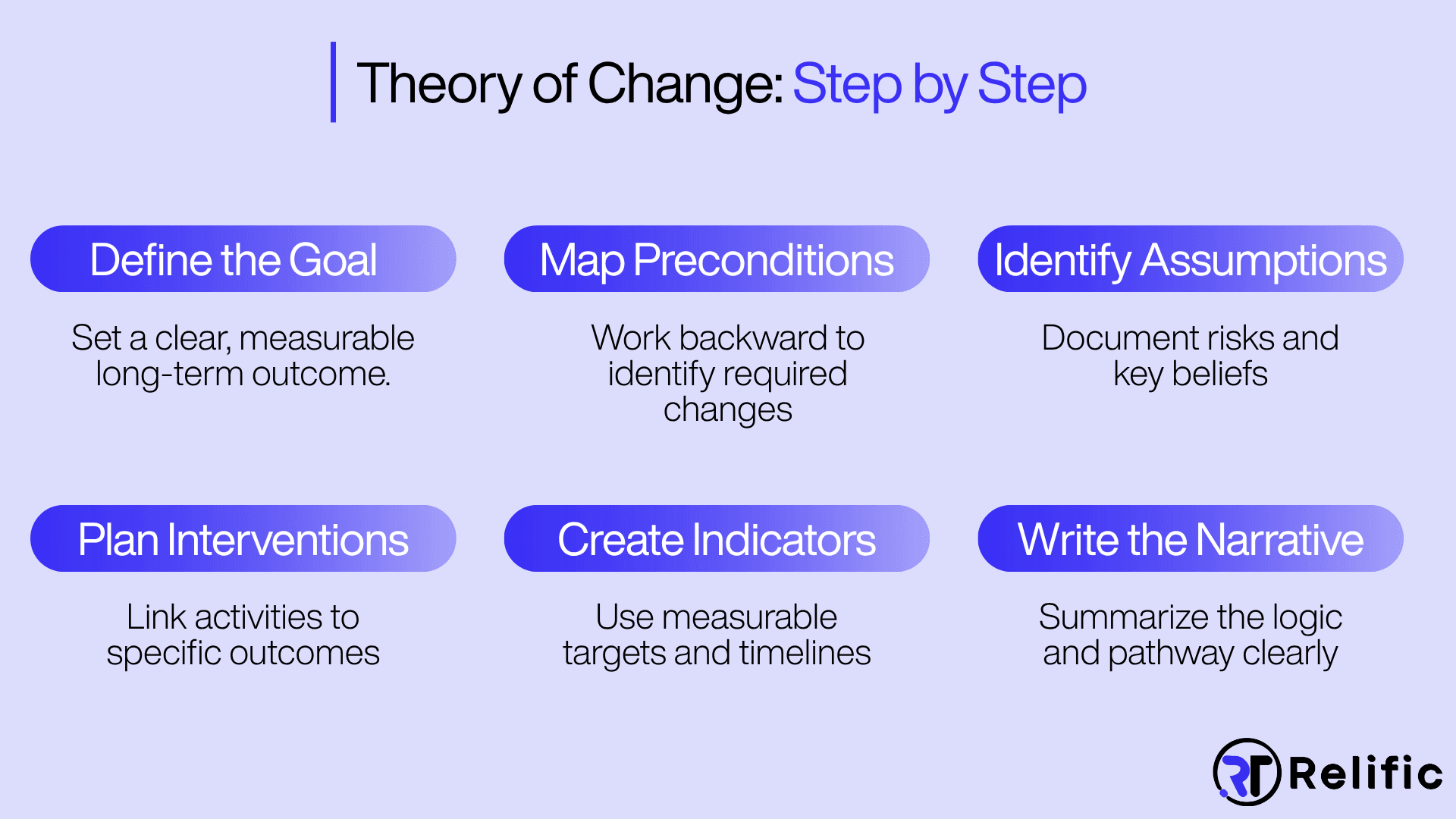
Quick answer: Build a theory of change in six steps: identify the long-term goal, work backwards to map the preconditions, state your assumptions, identify the interventions that will produce each precondition, develop indicators to measure each outcome, and write a narrative that ties the logic together.
The defining feature of the method is that you think in reverse. This is called backwar ds mapping, and it runs against the grain of how teams usually plan. Most planning starts with "what can we do?" A theory of change starts with "what must be true for the goal to happen?" and only reaches the question of activities near the end.
Here is the process the Centre for Theory of Change lays out, adapted into practical steps.
Name the long-term goal. Be specific about the population, the amount of change, and the timeframe. "Improve livelihoods" is not a goal; "raise the annual income of 1,000 smallholder farmers in the district by 30 per cent within four years" is.
Work backwards to map preconditions. Ask what conditions must already be in place for that goal to be reached, then what must be true for those conditions, and so on, down to the earliest changes you can influence. This produces a connected set of outcomes, the pathway of change, which becomes the skeleton of the whole theory. Aim for preconditions that are both necessary and, taken together, sufficient.
Surface your assumptions. As you build the pathway, write down what you are taking for granted: the contextual factors, the beliefs about why one outcome leads to another, and the claim that you have not missed any important precondition. Mark the assumptions that feel shaky. Those are your biggest risks.
Identify the interventions. Only now do you decide what the programme will actually do. Each intervention should map to a precondition it is meant to bring about. If an activity does not connect to any outcome on your pathway, ask why you are doing it.
Develop indicators. For each outcome that matters, define how you will measure it, with the population, target, threshold, and timeline spelt out. This is what makes the theory testable rather than rhetorical.
Write the narrative. Summarise the whole logic in one to two pages so that a funder, a board member, or a new colleague can follow it. The act of writing it almost always exposes gaps you missed in the diagram.
A theory of change is best built by a small core group of stakeholders rather than one person at a desk, because the assumptions worth testing are usually the ones a single perspective takes for granted.
Key takeaway: Build backwards from the goal, not forwards from your activities. Naming the destination first, then mapping every condition required to reach it, is what gives the method its rigour.
A Theory of Change Example
Abstract definitions only go so far, so here is a worked example. Imagine a foundation working to improve secondary-school completion among girls in a rural district, a goal that sits squarely within education, the single largest CSR sector in India.
Ultimate outcome (the vision): Women in the district have expanded economic and life choices. The foundation will not hold itself accountable for this, but it keeps it visible as the reason the work matters.
Long-term outcome (the goal): A higher share of girls in the target blocks complete Class 10. Indicator: 80 per cent of girls enrolled in Class 6 in the target blocks pass their Class 10 board exam within the five-year cohort window.
Working backwards, the pathway of preconditions looks like this:
| Level | Precondition (Outcome) | Why It Is Necessary |
|---|---|---|
| Late | Girls remain enrolled through Classes 6 to 10 | You cannot complete school if you have dropped out. |
| Middle | Families value and prioritise girls' continued schooling | In many households, a daughter's schooling competes with work, care duties, or early marriage. |
| Middle | Girls can attend safely and consistently | Distance, safety, and the absence of girls' toilets are documented reasons girls drop out. |
| Middle | Girls keep pace academically | Falling badly behind is itself a powerful driver of dropout. |
| Early | Families understand the economic return to girls' education | Belief change is a precondition for behaviour change. |
Interventions, each mapped to a precondition:
- Conditional stipends to reduce the opportunity cost of keeping a daughter in school (targets the "families prioritise schooling" precondition).
- Community sessions with parents on the returns to girls' education (targets the "families understand the return" precondition).
- Bicycle distribution and safe-transport arrangements, plus construction of functional girls' toilets at the schools (targets "girls can attend safely").
- After-school remedial classes (targets "girls keep pace academically").
Assumptions the foundation is relying on:
- Schools in the district remain staffed and operational. (Contextual.)
- The stipend amount is large enough to actually offset the family's opportunity cost. (A justification of the activity-to-outcome link, and a genuinely testable one.)
- Reducing the cost and safety barriers is not just necessary but sufficient to change family behaviour. (This is the kind of assumption a theory of change forces into the open. If social norms, rather than cost, are the binding constraint, the stipend alone will underperform, and the team should know that going in.)
- No major economic shock pulls girls into household labour during the period. (Contextual risk.)
The value of laying it out this way is immediate. The third assumption, that cost and safety are the binding constraints, is the one most likely to be wrong, and it is now visible enough to test early. If first-year data shows attendance rising where toilets were built but family decisions unchanged where only stipends were given, the foundation learns something important about its own logic long before the final evaluation.
Key takeaway: A worked theory of change turns a programme from a bundle of activities into a testable argument. The most useful thing it produces is not the diagram, but the list of assumptions you now know to watch.
A Theory of Change Template You Can Reuse
You do not need specialist software to start. The structure below works in a document, on a whiteboard, or as a visual canvas, and it follows the backwards-mapping logic. Fill it from the bottom up, beginning with the goal.
- Ultimate vision (optional): The broader change your work contributes to but is not accountable for.
- Long-term outcome (goal): One clear statement, with population, scale, and timeframe.
- Pathway of preconditions: List the outcomes that must occur, ordered from the earliest change you can influence up to the goal. Note where two outcomes reinforce each other.
- Interventions: For each precondition, the activity or strategy that will bring it about. Flag any intervention that does not map to a precondition.
- Assumptions: Separate your causal assumptions (why one step leads to the next) from your contextual assumptions (what the environment must provide). Mark the riskiest ones.
- Indicators: For each key outcome, define the population, target, threshold, and timeline.
- Narrative: One to two pages summarising the logic, the major assumptions, and the evidence behind your rationales.
A practical tip: keep the first version deliberately rough and get it in front of people who know the context. The point of the early draft is to provoke disagreement about the assumptions, which is where the real learning lives.
For teams that want to move beyond a static document, a visual Theory of Change canvas lets you build the pathway as connected nodes and link indicators directly to each outcome, so the framework stays live as field data comes in rather than sitting in a folder.
When to Use a Theory of Change (and When to Skip It)
Quick answer: Build a theory of change when you are designing a new programme, applying for outcomes-based funding, scaling a pilot, or trying to understand why an existing programme is not delivering. It is less useful for genuinely exploratory work where the outcome is not yet defined, or for simple, one-off activities with an obvious and immediate result.
A theory of change is most valuable when the path between effort and result is long, indirect, or contested, which describes most serious social and development work. The situations where it pays off clearly:
- Designing a new initiative, where the discipline of backwards mapping prevents you from building around easy-to-count activities.
- Seeking funding tied to outcomes, where funders increasingly want to see the logic, not just the budget.
- Scaling something that worked, where you need to be explicit about why it worked before assuming it will work elsewhere.
- Diagnosing a stalled programme, where comparing the intended pathway against reality often reveals the broken link.
It is worth less when the work is open-ended discovery with no fixed goal, or when an activity's effect is direct and obvious enough that mapping a causal chain adds nothing. Forcing a detailed theory of change onto genuinely exploratory work can create a false sense of certainty, which is its own kind of failure.
Common Theory of Change Mistakes
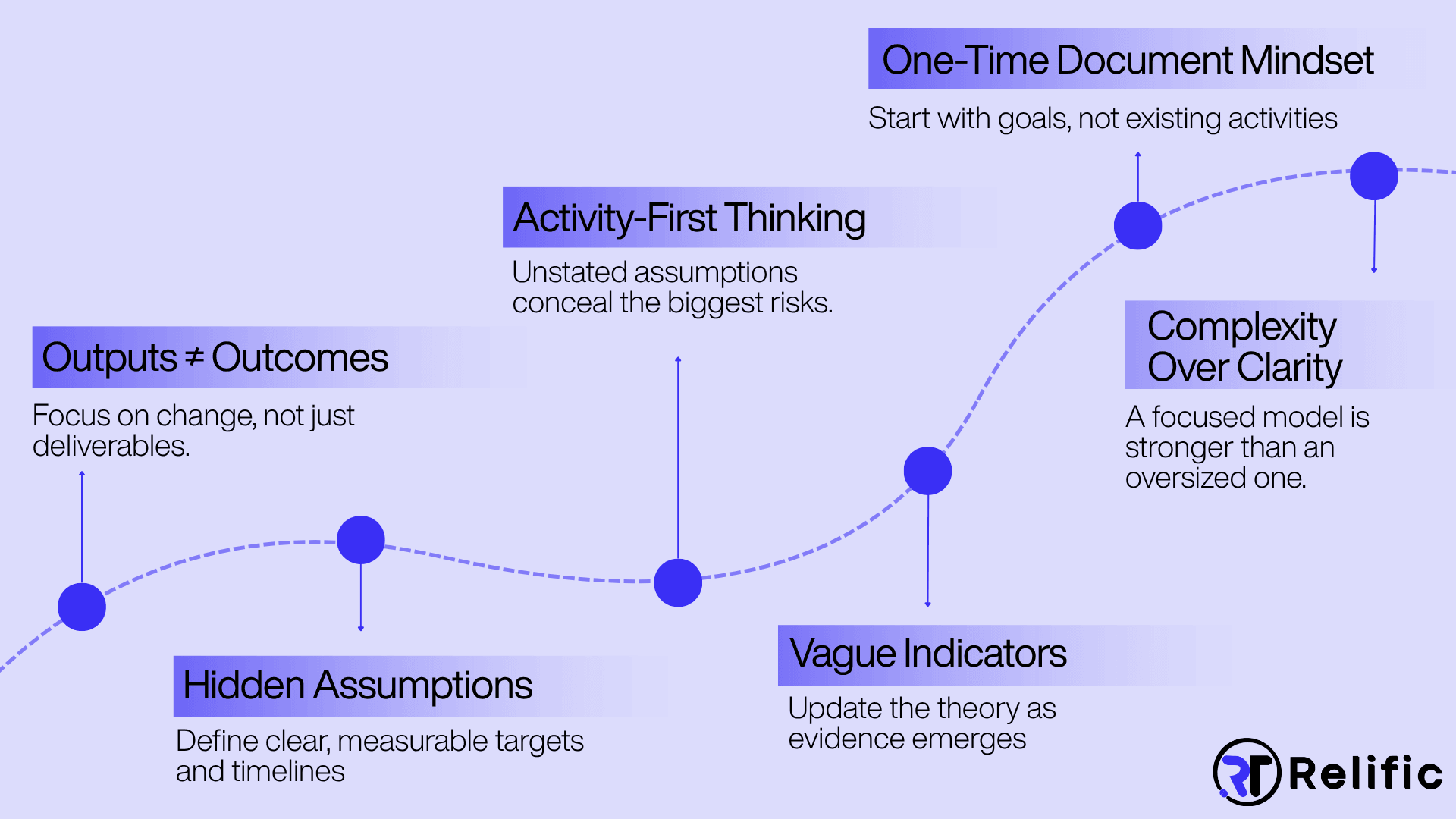
In my experience reviewing these documents, the same handful of errors recur, and most of them are failures of honesty rather than technique. Mistaking outputs for outcomes. This is the original sin. A pathway full of "deliver X" and "train Y" with no statement of the change those deliverables cause is an activity plan, not a theory of change. If every box describes something you do rather than something that changes, start again.
-
Leaving assumptions unstated. A theory of change with no explicit assumptions is hiding its weakest points. The assumptions are not an appendix; they are where the risk lives, and a document that buries them is less useful than one that admits them.
-
Working forwards from activities. Teams attached to their existing activities often reverse-engineer a goal to justify them. The tell is a pathway that conveniently requires exactly the activities the organisation already runs. Backwards mapping exists precisely to break this habit.
-
Vague indicators. "Improved wellbeing" cannot be measured, defended, or disproven. Without a population, target, threshold, and timeline, an indicator is decoration.
-
Treating it as a one-time document. A theory of change is a hypothesis, and hypotheses get tested. The teams that get value from it revisit it as evidence accumulates, revising the pathway when reality disagrees. The ones that do not file it after the grant application and never look again.
-
Confusing breadth with rigour. A sprawling diagram with fifty boxes is not more rigorous than a focused one with twelve. Scope is a choice. Decide how many pathways and how many levels of preconditions you can actually evidence, and resist the urge to map everything.
Most weak theories of change fail on honesty, not formatting. Name real outcomes, state your assumptions, build backwards, and treat the whole thing as a hypothesis you intend to test.
Theory of Change in India's CSR and Impact Sector
For organisations working in India, the theory of change has moved from a nice-to-have into the methodological backbone of how impact is now expected to be demonstrated.
The shift is driven by regulation. India's CSR regime is statutory rather than voluntary, governed by Section 135 of the Companies Act, 2013, which requires qualifying companies to spend at least 2 per cent of average net profits on activities listed under Schedule VII. The scale is significant: according to the Ministry of Corporate Affairs' National CSR Portal, Indian companies reported CSR spending of around ₹34,909 crore in FY 2023-24, the highest annual figure on record and the continuation of a steady multi-year rise.
Crucially, the rules no longer stop at spending. Companies with an average CSR obligation of ₹10 crore or more must commission an independent impact assessment of projects with outlays of ₹1 crore or more that were completed at least a year earlier, with the findings placed before the board and annexed to the annual CSR report. The regulatory direction is unmistakable: a move from measuring how much was spent toward measuring whether it worked. Reviews of CSR reporting consistently note that disclosure still leans toward activities, such as schools built, rather than outcomes, which is precisely the gap regulators are pushing to close.
This is where a theory of change does practical work. Impact assessment agencies routinely apply it alongside Social Return on Investment and OECD-DAC criteria, because a credible assessment needs a clear account of the outcomes a project was supposed to produce and the logic connecting activity to result. A programme designed with a theory of change from the start arrives at assessment with its outcomes, indicators, and assumptions already defined, rather than reconstructing them under deadline pressure. The same logic applies to foundations tracking grantees and to impact investors benchmarking outcomes across a portfolio.
The practical constraint is data. A theory of change is only as good as the evidence you can gather against its indicators, and much of India's impact work happens in low-connectivity rural districts. The ability to turn field data into outcome evidence, captured offline and linked back to the outcomes in your framework, is what keeps a theory of change from becoming a document that describes a programme no one is actually measuring.
Key takeaway: In India, a theory of change is increasingly the connective logic behind CSR impact assessment under Section 135. Designing programmes around outcomes from the outset, and capturing the field data to evidence them, is what turns regulatory compliance into genuine accountability.
Bringing It Together
A theory of change is, at heart, a refusal to let good intentions stand in for evidence. It asks you to state the change you want, trace honestly every condition required to reach it, admit what you are assuming, and commit to measuring whether the logic holds. None of that is comfortable, and that discomfort is the value. Programmes that do this well know where their risks sit before they spend the money, can tell a funder a credible story about causation, and learn from the gaps between their pathway and reality. Programmes that skip it tend to confuse motion with progress, and find out only at the end whether anything changed. The diagram is the easy part. The thinking it forces is the point.
Frequently Asked Questions
What is a theory of change in simple terms?
A theory of change is an explanation of how and why your work is expected to create a specific result. You name the goal, map every condition that has to be true for that goal to happen, connect those conditions to your activities, and state the assumptions you are relying on. It is your programme's logic, written down so it can be tested.
What is the difference between a theory of change and a logic model?
A logic model describes what a programme produces, in a linear flow from inputs to activities to outputs to outcomes to impact. A theory of change explains why you expect each of those links to hold. The logic model is a summary; the theory of change is the reasoning behind it. The cleanest practice is to build the theory of change first and derive the logic model from it.
What are the main components of a theory of change?
The core components are a long-term outcome (the goal), the preconditions or outcomes beneath it, the pathway linking them, the interventions, the assumptions, the rationales explaining why each step leads to the next, and indicators to measure progress. A written narrative ties it together. Some summaries condense this to five: outcome, preconditions, interventions, assumptions, and indicators.
Who invented the theory of change?
The term was popularised by sociologist Carol Weiss in a 1995 chapter for the Aspen Institute's Roundtable on Community Change, though the underlying ideas drew on earlier work in evaluation by thinkers such as Huey Chen, Peter Rossi, and Michael Quinn Patton. The Centre for Theory of Change, founded in 2002, later formalised much of the method.
What is backwards mapping in a theory of change?
Backwards mapping is the practice of starting with your long-term goal and working in reverse to identify the conditions that must be in place for it to occur, then the conditions required for those, and so on. It is the opposite of normal planning, which starts by asking what you can do. Backwards mapping asks what must be true first, and only reaches the question of activities at the end.
What is the difference between outputs and outcomes?
An output is what your programme delivers and can count directly, such as toilets built or people trained. An outcome is the change those outputs are meant to cause, such as girls staying in school or incomes rising. Outputs are within your control; outcomes are not. A theory of change exists largely to keep teams from reporting outputs as if they were outcomes.
When should you create a theory of change?
Create one when designing a new programme, applying for outcomes-based funding, scaling a pilot, or trying to understand why an existing programme is not working. It is less useful for open-ended exploratory work with no defined outcome, or for simple activities whose effect is direct and obvious.
How long should a theory of change be?
The diagram can be as detailed as your scope requires, but the accompanying narrative is usually kept to one or two pages. The aim of the narrative is to let someone unfamiliar with the programme follow the logic quickly, so brevity and clarity matter more than length.
What is the difference between an assumption and a precondition?
A precondition is an outcome that does not yet exist and that your programme has to bring about for the next step to follow. An assumption is a condition you believe already exists and will not be a problem, so you are relying on it rather than creating it. Both are necessary for success, but only preconditions are things you actively work to produce.
Is a theory of change required for CSR impact assessment in India?
It is not named as a legal requirement in itself, but it is widely used in practice. Under Section 135 of the Companies Act, 2013, larger CSR spenders must commission independent impact assessments, and assessment agencies commonly apply a theory of change alongside SROI and OECD-DAC frameworks to evaluate whether projects achieved their intended outcomes. Designing a programme with a theory of change makes that later assessment far easier.
Can a theory of change change over time?
Yes, and it should. A theory of change is a hypothesis about how change happens, and like any hypothesis it gets tested against evidence. As data comes in showing which parts of the pathway are holding and which are not, the framework should be revised. A theory of change that is never revisited has stopped doing its job.
What makes a theory of change credible?
Three things separate a credible theory of change from a decorative one: it names real outcomes rather than activities, it states its assumptions openly rather than hiding them, and its indicators are specified down to population, target, threshold, and timeline. A document that does all three can be tested and defended. One that does none is just an activity plan with arrows.