Key Takeaways
-
Precise vocabulary is a compliance issue, not a style choice. Regulators and evaluators treat "output", "outcome", and "impact" as distinct concepts. Conflating them changes the claims you can defend in a board report or a statutory filing.
-
In the Indian context, several of these terms carry statutory weight. Under Section 135, terms like Schedule VII, CSR impact assessment, and the Unspent CSR Account are defined by law and tied to hard deadlines and penalties, not general usage.
-
Global frameworks increasingly intersect with domestic CSR. Standards such as the SDGs, IRIS+, the OECD-DAC criteria, and ESG now shape Indian CSR reporting, particularly for companies with international investors or supply chains. The EU's CSRD is one to watch, though its 2026 simplification has narrowed its direct reach.
-
This is a quick-reference hub. Terms are grouped into five clusters so you can find what you need fast, with tight definitions and the distinctions that most often trip people up.
If you work in Corporate Social Responsibility (CSR), monitoring and evaluation (M&E), or the wider social sector, you will notice the same handful of terms doing most of the heavy lifting in funder calls, board reports, and compliance filings. The problem is that many of them are used loosely. "Impact" stands in for "activity", "monitoring" gets confused with "evaluation", and "output" and "outcome" are treated as synonyms even though they describe very different things.
That imprecision has a cost. In India, where Section 135 of the Companies Act, 2013 has turned measurement into a legal expectation rather than a nicety, reporting an output as an outcome or presenting monitoring data as evaluation evidence produces filings that auditors and boards cannot fully trust. This glossary defines the 25 terms that come up most often across CSR compliance, programme design, and impact reporting, and explains how to use each one correctly. The legal and regulatory details here reflect the position in 2026, including the recent changes to EU sustainability reporting rules.
How This Glossary Is Organised
The 25 terms sit in five groups:
- The Indian CSR compliance stack
- Planning and evaluation frameworks
- The results chain and proving change
- Funding, delivery, and accountability
- Global standards and sustainable finance
The Indian CSR Compliance Stack
CSR (Corporate Social Responsibility)
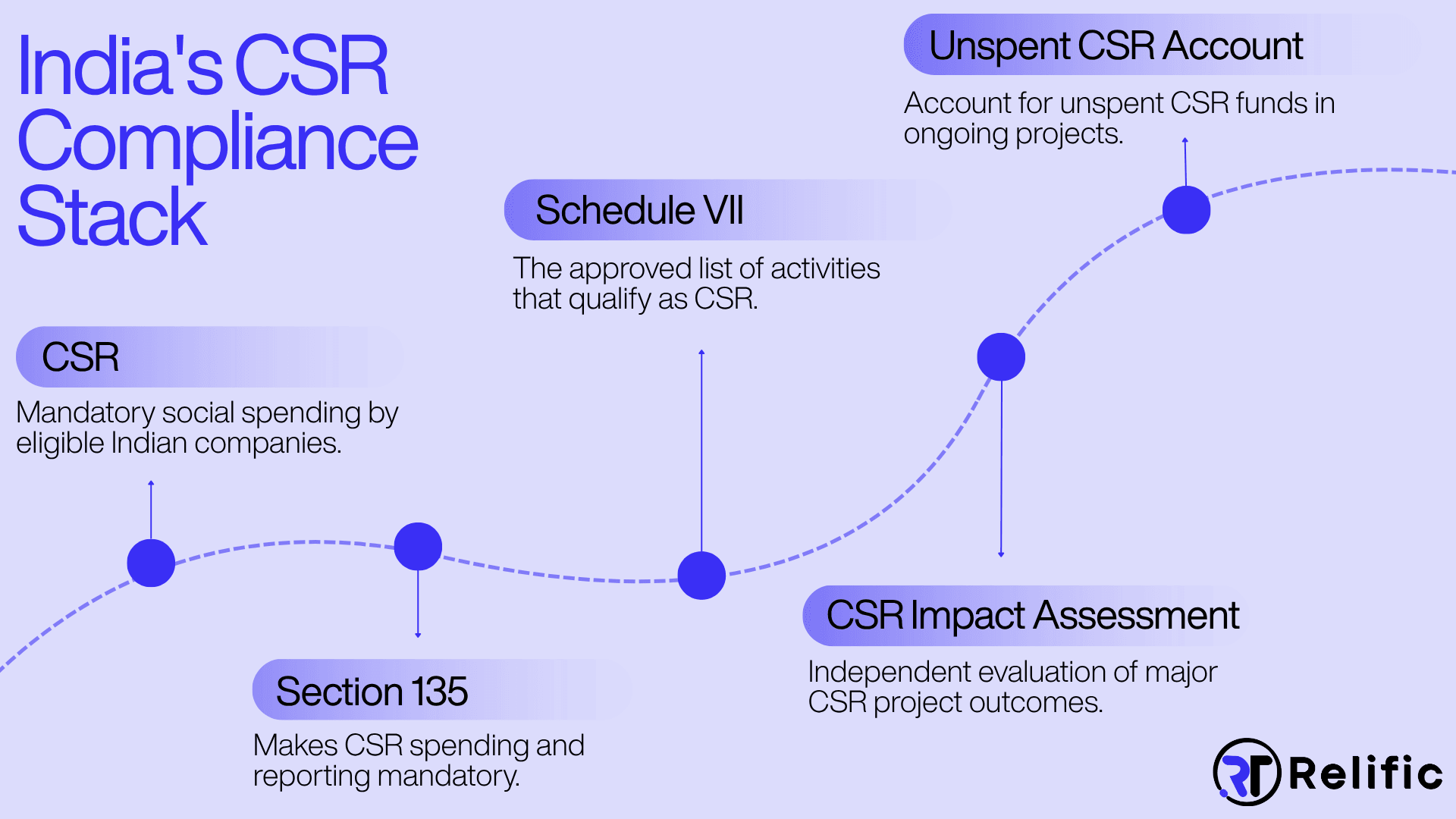
CSR is a company's spending and activity aimed at social, environmental, or economic development beyond its core commercial operations. In India, CSR is not voluntary for qualifying companies; it is a statutory obligation. Under Section 135 of the Companies Act, 2013, companies that cross specified thresholds must spend at least 2% of their average net profit from the preceding three financial years on eligible CSR activities.
Section 135 (Companies Act, 2013)
Section 135 is the legal provision that makes CSR spending, governance, and reporting mandatory for qualifying companies in India. CSR applies to any company that, in the immediately preceding financial year, had a net worth of ₹500 crore or more, a turnover of ₹1,000 crore or more, or a net profit of ₹5 crore or more. Meeting any one threshold is enough. Qualifying companies must constitute a CSR Committee, adopt a CSR policy, spend 2% of average net profit, and file an annual report on CSR. Non-compliance now carries monetary penalties: broadly, up to twice the amount that should have been transferred, or ₹1 crore, whichever is less, for the company, plus a smaller penalty on each officer in default.
Schedule VII
Schedule VII is the official list of activities that qualify as CSR under the Companies Act, 2013. It covers areas such as education, healthcare, poverty and hunger eradication, environmental sustainability, gender equality, and rural development. A company's spend only counts toward its 2% obligation if the activity falls within these categories. Misclassifying a project that sits outside Schedule VII, or one that benefits only the company's own employees, is one of the most common compliance mistakes.
CSR Impact Assessment
A CSR impact assessment is an independent evaluation required under the Companies (CSR Policy) Rules for larger CSR projects. The trigger has two parts: the company must have an average CSR obligation of ₹10 crore or more across the three immediately preceding financial years, and the project being assessed must have an outlay of ₹1 crore or more and have been completed not less than one year before the study begins.
The report goes to the board and is annexed to the annual report on CSR. Companies may book the assessment cost as CSR spend, capped at 5% of that year's CSR expenditure or ₹50 lakh, whichever is lower. This requirement signals India's shift from measuring spend to measuring results, and agencies typically draw on Theory of Change, SROI, and the OECD-DAC criteria to carry it out.
Unspent CSR Account
The Unspent CSR Account is a dedicated bank account into which a company must move CSR funds that are committed to an ongoing project but remain unspent at the end of a financial year. The transfer has to happen within 30 days of the financial year-end, and the money must be spent on that project within three financial years, failing which it goes to a Schedule VII fund. This is separate from the treatment of unspent funds that are not tied to an ongoing project: those must be transferred to a Schedule VII fund (such as the Prime Minister's National Relief Fund) within six months of the financial year-end. Missing either deadline is a frequent and avoidable cause of penalties.
Planning and Evaluation Frameworks
Theory of Change
A Theory of Change is a full description of how and why a desired change is expected to happen in a given context. It maps the causal pathway backwards from a long-term goal, setting out every precondition, intervention, and assumption along the way. It is the most widely used, and most frequently misunderstood, planning tool in the social sector. Its distinguishing feature is that it makes assumptions explicit, forcing you to state what has to be true for each step to lead to the next.
Logic Model
A logic model is a linear diagram showing the flow from inputs to activities to outputs to outcomes to impact. It gives a clean snapshot of what a programme produces, rather than an explanation of why each step causes the next. The two tools are complementary but not interchangeable.
| Aspect | Theory of Change | Logic Model |
|---|---|---|
| Core question | Why and how does the change happen? | What does the programme produce? |
| Form | Pathway diagram plus narrative | Linear flow diagram |
| Assumptions | Addressed explicitly, as a central feature | Rarely addressed |
| Best used as | A design and strategy tool | A quick, shareable summary |
Logframe (Logical Framework)
A logframe is a structured four-by-four matrix that sets goals, purposes, outputs, and activities against indicators, means of verification, and assumptions. It was developed in 1969 by Leon Rosenberg and colleagues for the United States Agency for International Development (USAID), and it remains the dominant format in international development funding, used by bodies such as the World Bank, the EU, and UN agencies. It is excellent for structured monitoring and donor reporting, but it can oversimplify the multi-pathway logic that a Theory of Change captures.
Monitoring and Evaluation (M&E)
Monitoring is the routine tracking of a programme's activities and outputs while it runs. Evaluation is the periodic, deeper assessment of whether a programme achieved its intended outcomes, and why. Monitoring answers "Is this happening as planned?" Evaluation answers "Did this work, and what caused the result?" Programmes need both. Monitoring without evaluation shows activity but not effectiveness; evaluation without monitoring means you discover implementation failures far too late to fix them.
OECD-DAC Criteria
The OECD-DAC criteria are six standard dimensions used worldwide to evaluate development programmes: relevance, coherence, effectiveness, efficiency, impact, and sustainability. The original five were revised in 2019, when coherence was added to better capture how an intervention fits alongside others. Indian CSR impact assessment agencies often use these criteria to give evaluators a consistent, cross-sector checklist. You can read the current definitions on the OECD's evaluation criteria page.
The Results Chain and Proving Change
Outputs vs Outcomes vs Impact
These three terms mark different points on a results chain, and conflating them is the single most common error in impact reporting.
| Term | What it means | Example |
|---|---|---|
| Output | What the programme directly delivers | 2,000 farmers trained |
| Outcome | The change that delivery is meant to cause | Farmer incomes rise by 30% |
| Impact | The longer-term, broader effect | District-level poverty falls |
Outputs are within your direct control. Outcomes and impacts take longer, are harder to measure, and are rarely attributable to a single intervention.
Indicator (KPI)
An indicator is the specific, measurable evidence used to judge whether an outcome has been achieved. A strong indicator specifies four things: the population, the target, the threshold for success, and the timeline. "Improved education" is not an indicator. "80% of girls enrolled in Class 6 in the target blocks pass their Class 10 board exam within five years" is a strong one, because it can be measured and either met or missed.
Baseline and Endline Survey
A baseline survey captures conditions before a programme begins; an endline survey captures conditions after it concludes. The difference between the two is what lets you claim that an outcome actually changed. Without a baseline, reporting that "60% of households now have safe drinking water" says nothing about whether that is an improvement, a decline, or no change at all.
Attribution vs Contribution
Attribution is the claim that your intervention, specifically, caused an observed change. Contribution is the more modest and usually more honest claim that your intervention was one of several factors that helped produce it. Because most social outcomes are shaped by many forces at once, credible reporting is careful about which claim it makes. Overclaiming attribution, where only contribution can be evidenced, is a fast way to lose an evaluator's confidence.
Counterfactual (and RCTs)
A counterfactual is an estimate of what would have happened to your beneficiaries in the absence of the programme. It is the logical heart of any rigorous impact claim, because "impact" is really the gap between what happened and what would have happened anyway. Randomised controlled trials (RCTs), which compare a treatment group against a similar control group, are the most robust way to construct a counterfactual, though they are expensive and not always practical. Where an RCT is not feasible, evaluators use quasi-experimental methods to approximate the same comparison.
Funding, Delivery, and Accountability
Beneficiary
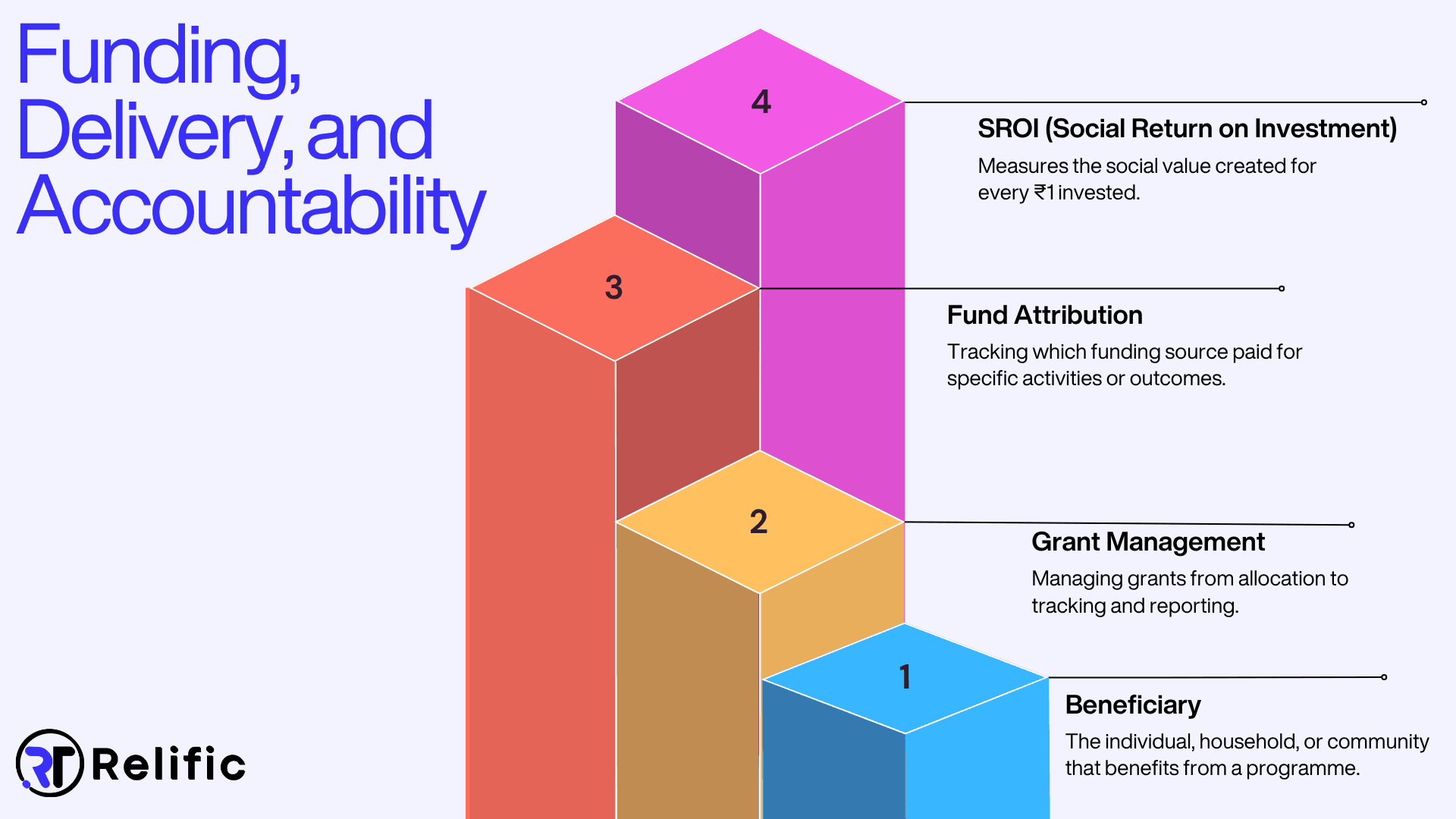
A beneficiary is the individual, household, or community that a programme's activities are designed to reach and benefit. In field data collection, beneficiary-level records tied to a unique ID or geo-tag let a programme move from aggregate headcounts to individually verifiable, auditable reach. Many practitioners now prefer the term "rights-holder", which frames the same people as holders of entitlements rather than passive recipients.
Grant Management
Grant management is the end-to-end process of allocating, disbursing, tracking, and reporting on funds given to implementing partners or grantees. It covers due diligence, budget tracking, milestone-linked disbursements, and utilisation certificates. Because regulators expect clean audit trails, this is increasingly run through dedicated software rather than spreadsheets.
Fund Attribution
Fund attribution is the practice of tracing which specific funding source financed which specific activity, outcome, or beneficiary. It matters most when several donors co-fund a project. Each funder needs to show cleanly which rupee produced which result, rather than reporting blended totals that no single funder can accurately claim as its own. Note that this is a financial traceability question, distinct from the causal attribution described earlier.
SROI (Social Return on Investment)
SROI is a framework that assigns a monetary value to social, environmental, and economic outcomes, then expresses the value created as a ratio against the money invested, for example "₹4 of social value for every ₹1 spent". It is widely used in Indian CSR impact assessments because it produces a single, communicable figure. It also draws steady criticism, because monetising outcomes such as improved well-being involves judgement calls that different analysts would make differently.
Global Standards and Sustainable Finance
ESG (Environmental, Social, Governance)
ESG refers to three categories of non-financial factors used to assess a company's sustainability and ethical conduct. ESG is broader than CSR. Where CSR focuses on social spending and community programmes, ESG covers the full spectrum of how a company operates, and it weighs heavily on investor decisions and regulatory disclosures. In short, CSR is largely about how a company gives back; ESG is about how it runs its business.
Double Materiality
Double materiality is the principle that a company should report both on how sustainability issues affect its financial performance and on how the company's own activities affect people and the environment. The first lens is "outside-in" (financial materiality); the second is "inside-out" (impact materiality). It sits at the centre of EU sustainability reporting and is a useful discipline for any organisation deciding which issues are material enough to measure and disclose.
CSRD (Corporate Sustainability Reporting Directive)
The CSRD is an EU regulation requiring in-scope companies to report standardised, assured sustainability information. Its scope changed substantially in early 2026: under the EU's Omnibus I simplification package, formally adopted on 24 February 2026, the thresholds were raised sharply (broadly, to companies with more than 1,000 employees and over €450 million in net turnover), most listed SMEs were removed from scope, and smaller suppliers gained protection from excessive data requests. The practical effect is that CSRD's direct reach is now narrower than earlier commentary suggested. For Indian companies, it remains relevant mainly for large groups with significant EU operations, or those supplying customers that are still in scope, rather than as an obligation that cascades automatically down every supply chain.
SDGs and IRIS+ Metrics
The Sustainable Development Goals (SDGs) are the United Nations' 17 global goals for 2030. IRIS+, maintained by the Global Impact Investing Network, is a standardised catalogue of metrics for measuring performance against those goals in comparable, auditable terms. Modern CSR and impact reports frequently map outcomes to specific SDG targets using IRIS+ definitions, so that results can be compared across organisations rather than only interpreted internally.
Impact Investing
Impact investing is the allocation of capital to companies or projects with the explicit intention of generating measurable social or environmental impact alongside a financial return. It sits at the intersection of philanthropy and finance. Impact investors benchmark outcomes rigorously, often with IRIS+, and expect the same measurement discipline that a foundation would apply to its grantees.
Additionality
Additionality is the test of whether an outcome, or a piece of capital, produced something that would not have happened otherwise. In impact investing, it asks whether an investment created impact beyond what ordinary market capital would already have delivered. It is a close cousin of the counterfactual: both push you to separate genuine, added effect from change that was going to occur regardless. Weak additionality is one of the sharpest criticisms levelled at loosely defined impact claims.
Where Teams Most Often Slip
Most confusion in CSR and impact reporting does not come from complicated ideas. It comes from loose language. The recurring errors are predictable: reporting an output as if it were an outcome, calling a logframe a Theory of Change, presenting monitoring data as evaluation evidence, claiming attribution where only contribution can be shown, and misclassifying a project that sits outside Schedule VII. Each slip is small on its own. Together, they produce reports that a board, an auditor, or an AI-assisted reviewer cannot fully rely on.
Getting the vocabulary right is one of the cheapest ways to make a CSR programme, and the reporting around it, genuinely credible.
Bringing the Vocabulary Into Practice
Much of the "loose language" problem starts at the point of data entry. When a complex, multi-partner programme is tracked on static spreadsheets, it is easy to log a headcount in a cell meant for an outcome, or to lose the thread of which funder paid for which result. Purpose-built platforms close that gap by linking field data directly to the frameworks in this glossary.
This is the problem Relific is built to solve. Its grant and project management tools handle allocation, disbursement, and audit trails, while its reporting tools map field data to frameworks such as the SDGs and IRIS+, so that every term in a board report is backed by a verifiable data trail. The result is that teams spend less time on administrative tracking and more on the work that produces impact.
Want a working reference for how these terms show up in day-to-day CSR compliance and impact reporting? Relific brings Theory of Change canvases, Section 135 compliance tracking, and outcome-linked field data into one system, so the vocabulary in this glossary maps directly to what your team measures.
Frequently Asked Questions
Is CSR mandatory for every company in India?
No. CSR under Section 135 applies only to companies that, in the immediately preceding financial year, met at least one of three thresholds: net worth of ₹500 crore or more, turnover of ₹1,000 crore or more, or net profit of ₹5 crore or more. Applicability is tested every year against the previous year's financials, so a company can move in and out of scope.
What is the difference between an output, an outcome, and an impact?
An output is what you directly deliver, such as 500 women trained. An outcome is the change that delivery causes, such as those women securing higher-paying work. Impact is the broader, longer-term effect, such as a measurable fall in regional gender wealth disparity. Outputs are within your control; outcomes and impacts take longer and are harder to attribute to any single cause.
When is a CSR impact assessment legally required?
It is required when a company has an average CSR obligation of ₹10 crore or more across the three immediately preceding financial years, for any project with an outlay of ₹1 crore or more that was completed at least one year before the study. The assessment must be done by an independent agency, placed before the board, and annexed to the annual report on CSR.
What happens to CSR funds a company fails to spend?
It depends on whether the funds relate to an ongoing project. Money committed to an ongoing project must move to a dedicated Unspent CSR Account within 30 days of the financial year-end and be spent within three years. Money not tied to an ongoing project must go to a Schedule VII fund, such as the Prime Minister's National Relief Fund, within six months of the financial year-end. Missing either deadline attracts penalties on the company and its officers.
Should I use a Theory of Change, a Logic Model, or a Logframe?
Use a Theory of Change during design, to map why and how you expect change to happen and to surface your assumptions. Use a Logic Model when you need a clean, linear summary of what your programme produces. Use a Logframe for structured, day-to-day monitoring and donor reporting, where a defined matrix of indicators and verification sources is expected. They are complementary tools, not competing ones.
Why do both a baseline and an endline survey matter?
A baseline captures conditions before you start; an endline captures them after you finish. Without a baseline as a reference point, an endline figure is just a standalone number. It cannot show whether your programme caused an improvement, a decline, or no change at all.
What is the difference between CSR and ESG?
CSR centres on a company's social spending, community programmes, and philanthropic initiatives, essentially how it gives back. ESG is a broader framework that evaluates the company's core operational conduct across environmental, social, and governance factors, primarily to inform investors and regulators. A company can run a strong CSR programme and still have a weak ESG profile, and the reverse is also true.
Does the EU's CSRD affect Indian companies?
For most Indian companies, not directly, and less than it once did. After the Omnibus I package adopted in February 2026, CSRD applies to a much smaller set of large companies, and smaller suppliers are protected from excessive information requests. It stays relevant chiefly for large Indian groups with substantial EU operations, or those that supply EU customers still within scope, who may face reporting duties or data requests as a result.
What is the difference between attribution and contribution?
Attribution claims that your intervention specifically caused a result. Contribution claims that your intervention was one of several factors that helped produce it. Because most social outcomes have many causes, contribution is usually the more defensible claim, and overstating attribution is a common way to undermine an otherwise sound report.
How do the SDGs relate to corporate CSR reporting?
The SDGs give global development a common language of 17 goals for 2030. By mapping local CSR outcomes to specific SDG targets, often using standardised IRIS+ metrics, a company can show investors, regulators, and the public how its localised work connects to shared global objectives, in terms that are comparable across organisations.