Measure impact, optimize CSR, and prove value with this practical guide.
Written by Manjunatha Thyagaraj, founder of Relific Technologies and a leading voice on technology-driven social impact.
Key Takeaways
1. Outputs are lies. Outcomes are true.
You didn't build 100 toilets; you reduced disease rates by 40%. Donors fund the second number, not the first. If you can't draw a direct line from your activity to a changed life, you're measuring the wrong thing.
2. The 3 P's are your survival strategy, not a framework.
Prove = Keep your funding (data-backed grant renewals). Improve = Stop bleeding money on failed experiments. Publicise = Attract better partners. Master these or watch competitors take your donors.
3. Start with ONE metric you'd bet your job on.
Not five. Not ten. One outcome that, if it fails, means your entire program failed. Track it weekly for 90 days. Most organisations die from "measurement overwhelm" trying to track everything and learning nothing.
4. Bad data beats no data. Every single time.
When Udaan discovered only a 60% grade improvement despite 85% attendance, they didn't hide it; they fixed their teaching method and became fundable. Organisations that fear honest metrics are doomed to repeat expensive mistakes in the dark.
5. Free tools + weekly discipline > Expensive software + monthly neglect.
Google Forms, 15-minute beneficiary phone calls, and a simple spreadsheet used EVERY week will teach you more than a ₹5 lakh platform you check quarterly. Consistency beats sophistication.
6. India's SSE made this mandatory, not optional.
To raise funds through the Social Stock Exchange, you MUST produce audited impact reports. This isn't "best practice" anymore, it's the literal price of entry. Organisations without a measurement infrastructure are now legally unfundable for serious capital.

I've seen it time and again in my work with impact-driven organisations. The client who built a brand-new school with millions of dollars, only to watch dropout rates stay exactly where they were. The team that distributed thousands of water filters saw little to no improvement in the community's health.
I learned a hard, painful lesson from all this: just wanting to do good isn't enough. I'm haunted by the fear that our hard work won't actually last. It’s the secret anxiety all of us in this work carry, that quiet dread that everything we're pouring our hearts into is just vanishing.
The amount of money is truly mind-boggling. Thanks to a mandatory CSR law, Indian companies have invested an incredible ₹1.53 lakh crore in social development since 2014. In a decade, corporate CSR spending has more than tripled, reaching over ₹34,900 crore in 2023-24, with education and health consistently receiving the lion's share of funds.
This guide provides the answer. It moves you from counting activities ("how much we spent") to measuring social impact ("what truly changed").
In this complete guide, you will learn:
- What social impact measurement really means (in simple terms).
- A proven, 3-P framework to Prove, Improve, & Publicise your work.
- Simple tools and metrics (like the Logic Model and SROI) you can use today.
- How to avoid common pitfalls and tell your story with data.
But despite these huge figures, a nagging question remains: is it actually working? We've gotten very good at counting the money we spend, but not so good at measuring the change we create. Companies can tell you exactly how many people they've reached, but often can't say if those people's lives have truly improved in the long run. We're stuck celebrating the investment, without knowing the real return for society.
We often end up talking about “how much we spent” instead of “what truly changed.” And that’s where the gap shows up between what we set out to do and the real impact people actually feel.
As Shiv Nadar reminds us, “We know that the profitable growth of our company depends on the economic, environmental, and social sustainability of our communities across the world. And we know it is in our best interests to contribute to the sustainability of those communities.”
What he’s really saying is simple but powerful: business and community are deeply connected. Impact isn’t just about meeting compliance standards or writing cheques for charity; it’s about making sure growth benefits everyone, so both companies and communities move forward together.
What Is Social Impact Measurement?
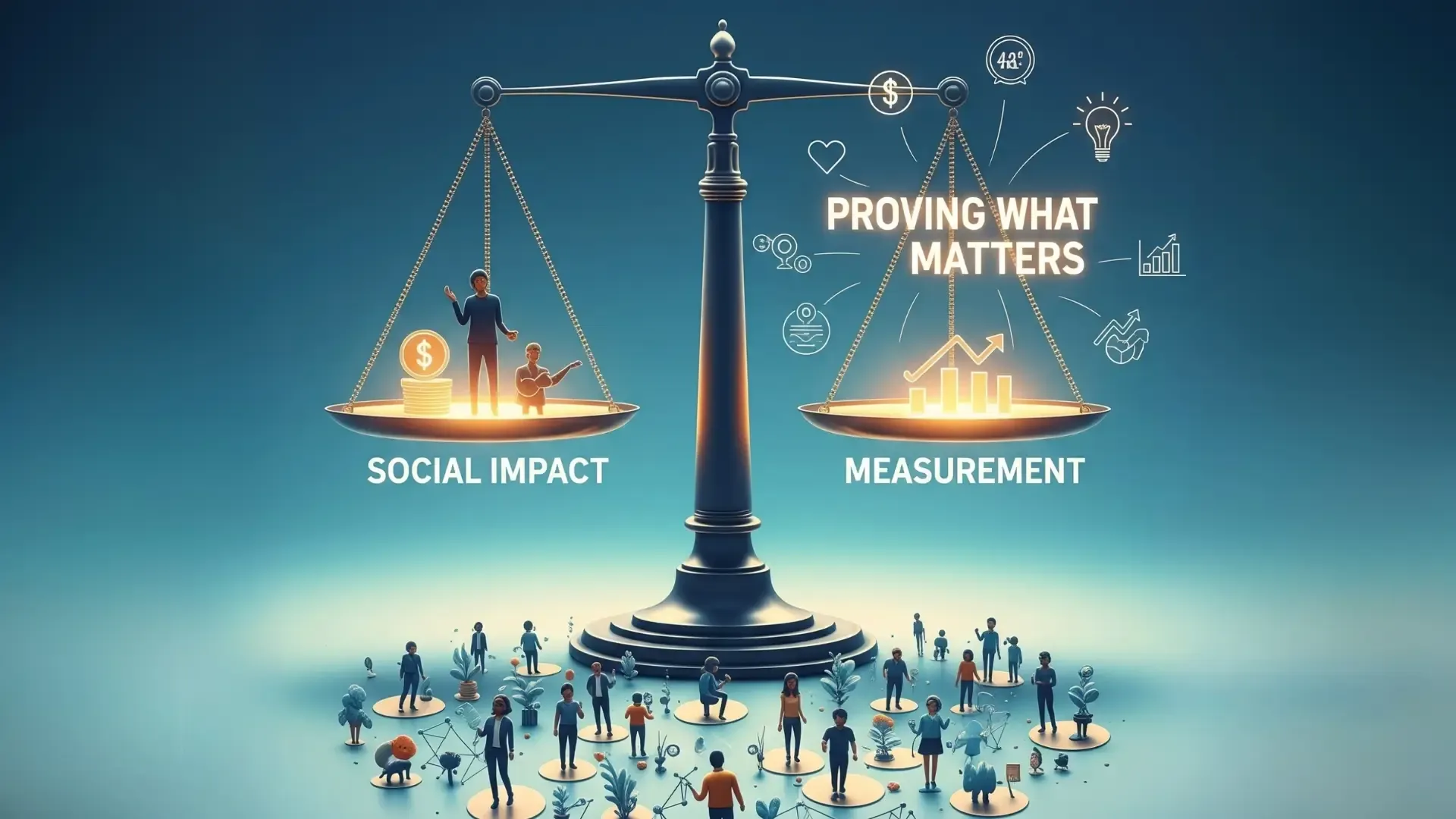
Social impact measurement is the systematic process of collecting, analysing, and reporting on the social, economic, and environmental changes that result from an organisation's activities.
It goes beyond simply counting outputs (e.g., number of people served) to assess the actual outcomes and long-term effects on individuals and communities.
We need to know if we're really helping, if our work is making a truly positive difference. This is how we can show our impact, make informed choices based on facts, and continually improve our performance.
Malcolm Brinded put it perfectly: Companies ignoring sustainability will not survive long." This just proves that measuring our impact isn't a "nice to have." It's fundamental. It's how we stay relevant, build resilience, and take real responsibility.
It might sound like a stiff, corporate buzzword, but it's not just about paperwork. Real impact measurement is about connecting your passion to actual change. It’s how we blend hard data with human stories to see the true worth of what we do and, most importantly, learn how to do it better.
Think about it: a CSR report might proudly declare, "We spent ₹500 crore on community development." That number sounds impressive, but what does it actually mean for the people on the ground? Did it improve a child’s health? Did it help a family escape poverty? That’s the crucial question that this traditional, data-heavy form of measuring social impact completely misses.
"Measuring what matters isn't just about counting what's easy to count. It's about having the courage to look beyond the numbers and ask: 'Did we create a ripple, or just make a splash?'" — Manjunatha Thyagaraj, Founder, Relific
We believe it’s time to change the conversation.
Impact measurement is more than just a task; it’s about connecting your passion to genuine change. It’s the art of bringing numbers and human stories together to see the true value of your work. As Malcolm Brinded aptly noted, “Companies not interested in sustainable development issues will not survive long.” This underscores why measuring impact isn’t optional; it’s essential for long-term relevance, resilience, and responsibility.
The Three Types of Social Impacts: Stop Counting Activity, Start Proving Change
Before you measure anything, get this: not all metrics matter. Most places waste time tracking the wrong things. They celebrate how busy they were, instead of proving that lives actually changed for the better.
Here are the three tiers every impact measurement system needs, and why most get stuck at level one.
Activity Metrics: Proof You Showed Up
What it answers: "Did we do the work?"
Examples:
- Conducted 42 training workshops
- Deployed 15 volunteers
- Distributed ₹12 lakh in program funds
Why it’s not enough: Just because you did a lot of things doesn’t mean it matters. You could run a hundred workshops and change nothing if they’re bad or if you don’t reach the right people.
When to use it: To show boards you’ve carried out the operations you’ve promised and have justified the expenditures.
Output Metrics: Proof People Engaged
What it answers: "Did people show up and participate?"
Examples:
- 78% of enrolled participants completed the full training
- 450 families received and activated water purification kits
- 92 students graduated with certificates
Why it's not enough: Completion ≠ transformation. A student can finish your course and learn nothing. A family can receive a filter and never use it.
When to use it: To show delivery capacity and engagement rates to potential funders.
Outcome Metrics: Proof Lives Actually Changed
What does this answer: “Does our presence benefit people for the better?”
Examples:
- 67% of graduates found jobs in the first 4 months (comparatively, 23% baseline)
- There was a 52% reduction of waterborne illness in the program villages as opposed to 8% in the control areas.
- One year, student math scores improved from 34% to 71% proficiency.
Why this is non-negotiable: This is the only tier that proves real impact. It's what donors fund, boards respect, and beneficiaries care about.
When to use it: Always. This should dominate your impact reports and grant proposals.
The Fatal Mistake: Building the Pyramid Upside Down
Most organisations spend 80% of their report on activities ("We held 60 workshops!"), 15% on outputs ("450 women participated!"), and barely mention outcomes.
Flip it.
Your next report should start with the heart: "We helped 306 women escape poverty." The proof? 68% launched businesses are still open after a year. We got there with 60 workshops, and 92% of the women completed the program.
Quick Audit: What Are You Actually Measuring?
Look at your last annual report or grant proposal. Count how many times you mention:
- Activities ("We conducted... We distributed... We held...")
- Outputs ("X people completed... Y% participated...")
- Outcomes ("Income increased by... Disease rates fell... Skills improved from X to Y...")
If activities dominate, you're proving you were busy, not effective.
If outcomes dominate, you're proving you changed lives, and that's what gets funded.
The bottom line: Your donors don't pay you to be busy. They pay you to create measurable change. If you can't articulate the difference between "We trained 500 people" and "500 people now earn ₹5,000 more per month," you're not measuring impact, you're just counting activities.
How to Measure Social Impact: A Simple Framework (The 3 P’s)
You’ve already seen that social impact measurement goes far beyond paperwork; it’s about uncovering a deeper truth. But the real question is: how do you actually put that idea into practice?
This is where the framework of the 3 P’s comes in. Think of it as a simple guide that helps you assess your work and shows the value of your work. It’s more than a reporting tool. It’s a compass that allows you to craft your narrative in real-time while transforming daily contributions into a tangible and impactful wave of change.
Prove: Measuring Social Impact Outcomes (Not Just Outputs)
This is the most critical step. It’s about moving past what you did and focusing on what changed. This is the essence of how to prove social impact.
-
Outputs are what you produce: 100 workshops conducted, 5,000 trees planted, 200 people given a meal. They are easy to count, but don't tell the whole story.
-
Outcomes are the changes that result from your actions: 70% of participants improved skills, a local forest cover increased by 10%, and families had enough food for a week. This is the real social impact of the measurable change in people’s lives.
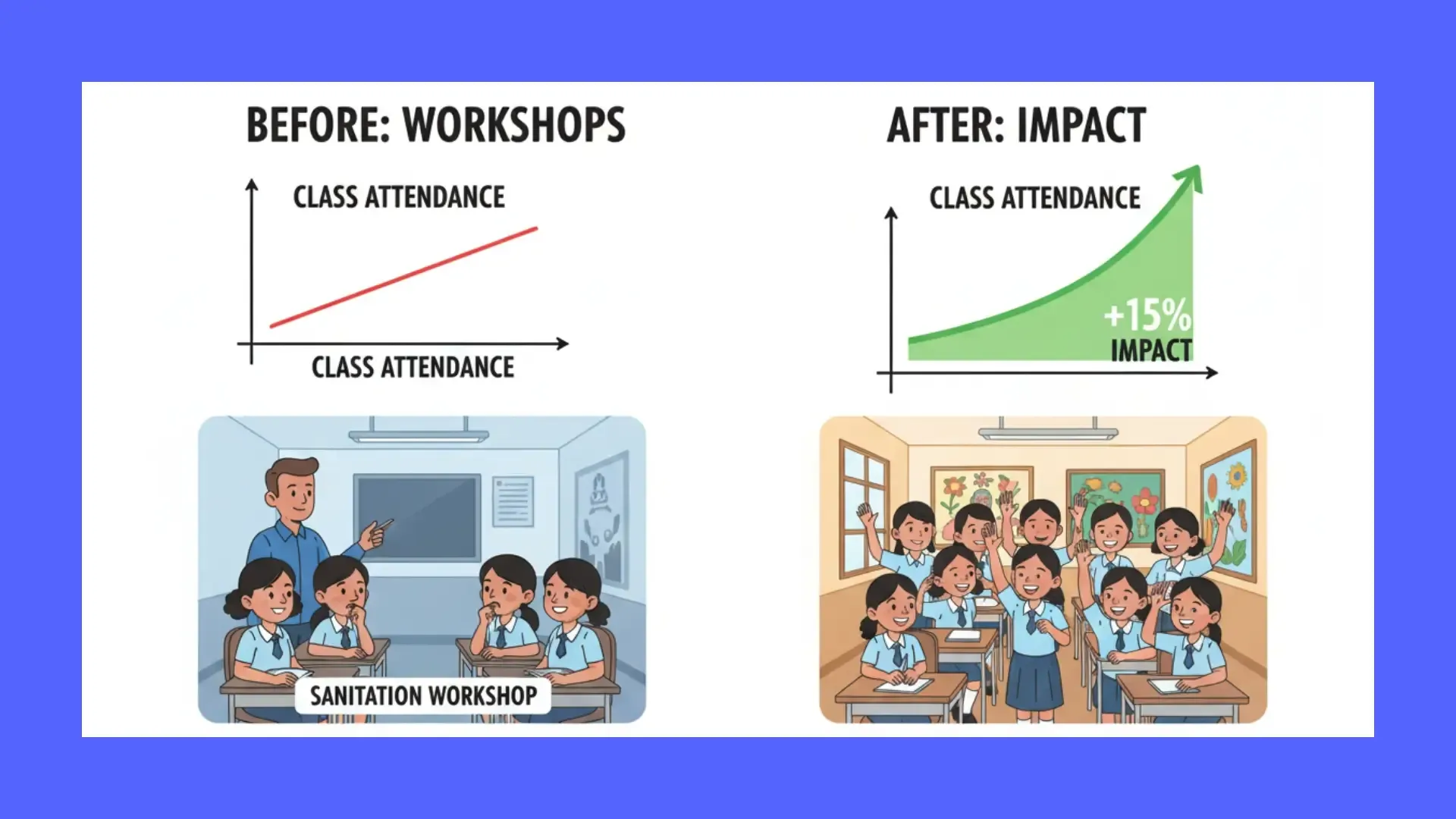
Consider an example from an NGO in Maharashtra. They performed an activity, running sanitation workshops (that’s an output). But interacting with families and resourcing data, they showcased that these workshops led to a 15% decrease in absenteeism among girls in school (that’s an outcome!). This shows a clear shift from activity to tangible results.
Improve: Using Social Impact Metrics as a Feedback Loop
Tracking your social impact shouldn’t seem like a punishment. Consider them as a part of your work compass. They lead your work to show what is working and what is not to help you adjust and enhance. This is how nonprofits stop just measuring activities and prioritise real change.
In Rajasthan, a rural water project monitored how often pumps broke down. Data collection showed pumps were failing too often because the local water had a lot of minerals. With this information, they changed the strategy to use more durable materials, which improved the project's impact in the long run.

Publicise: Mastering Social Impact Reporting
Data is important, but it’s stories that touch the heart. The most effective social impact reporting integrates numbers with powerful narratives, creating a tangible and relatable account of your work.

Consider what the Infosys Foundation does. They mention they have provided "2 million meals'' which is certainly an enormous figure. However, what really counts is the story of the families behind those meals they provided. This is the human dimension behind the big figures. This combination is what makes a social impact report feel alive and worthwhile. It helps assess the impact credibility and builds trust with compassionate donors.
Social Impact Measurement Tools & Metrics

You don’t need a lot of money or a bunch of data scientists to start measuring social impact. Sometimes, a notebook and a little bit of time or a free online tool are all you need. The important thing is finding the right framework to show you the way and prove your work really makes a difference.
Beyond Financials: The Power of Qualitative vs. Quantitative Metrics
A complete social impact assessment combines quantitative and qualitative approaches to derive the fullest extent of the value of your work.
| Metric Type | What It Measures | Example |
|---|---|---|
| Quantitative | The "What" or "How Many" (Numbers) | "Percentage of children attending school." |
| Qualitative | The "Why" or "How" (Stories) | "How do you feel about your child’s education since joining the program?" |
-
Quantitative Metrics are the numbers you can count and analyse. They provide scale and hard evidence.
- Percentage of children attending school.
- Number of households reached.
- Rupees saved by a community health program.
-
Qualitative Metrics are about understanding the human experience behind the numbers. They capture the "why" and "how" of the change.
- How do you feel about your child’s education since joining the program?
- What was the most significant change you experienced in your life?
- Describe how your daily routine has changed since using the new toilet.
A strong social impact report combines both, showing not only that you served 100 families but also how those families' lives improved.
The Logic Model: A Framework for Measuring Nonprofit Impact
The Logic Model is really just a simple map for your program. It helps you see how the small things you do every day connect to the bigger changes you want to make. It lays everything out in a clear, step-by-step way, so you can understand your work and its impact more easily.
-
Inputs: The resources you invest (volunteers, funds, equipment).
-
Activities: What you actually do (tutoring sessions, health camps).
-
Outputs: The direct, immediate results of your activities (# of sessions held, # of people attending).
-
Outcomes: The short- to medium-term changes in people’s lives (improved exam scores, better hygiene practices).
-
Impact: The long-term, lasting change (better career opportunities, reduced disease rates).
Think of it as a roadmap for how to measure social impact for a non-profit.
How to Design Social Impact Metrics (A 4-Step Guide)
Let’s now take that Logic Model and turn it into a practical strategy. Designing impactful metrics isn't that difficult; it’s a matter of asking the right questions. Here’s a simple, step-by-step guide to help you begin.
-
Start with the Outcome: Instead of thinking about what you will do, think about what you want to change. What is the single most important result of your work?
- Example Outcome: "A community health program aims to reduce the spread of waterborne diseases."
-
Work Back to Your Activities: Now, what activities are you doing to achieve that outcome?
- Example Activities: Holding sanitation workshops, distributing water filters, and conducting house-to-house check-ups.
-
Define Your Metrics (Quant & Qual): For each task and result, figure out one precise way to measure. Focusing on both the numbers and the narrative is crucial.
- A quantitative measure could be tracking the proportion of households that implement water filters from 10% to 75% over the course of a year.
- Qualitative Metric: You could collect a quote or story, such as: "My family used to get sick every month, but since using the new filter, we haven't had a single fever."
-
Create a Simple Table: Organise your metrics in a table. This makes it easy to track your progress and see the full picture at a glance.
Know Your ABCs: Activity, Output, and Outcome Indicators
We know that your program's Logic Model is a blueprint. Now, we identify the three indicators that will help you realise the blueprint. These will help you measure your blueprint: Activities, Outputs, Outcomes.
| Indicator Type | What It Measures | Example for a Skills Training Program |
|---|---|---|
| Activity | The actions you take. What do you do? | The number of training sessions held. |
| Output | The direct, tangible result of your activities. What you produce. | The number of participants who completed the training. |
| Outcome | The change that happens because of your work. What was achieved? | The percentage of participants who gained employment or a promotion within six months. |
What is Social Return on Investment (SROI)?
- Social Return on Investment (SROI) is more than just a metric; it's a way to tell your complete value story. It's a method that helps you translate the often intangible benefits of your work into a tangible, monetary figure. This allows you to answer a crucial question: "For every rupee we invest, what is the total social and economic value created?"
While the full methodology (defined by Social Value International) can be complex, the core idea is a simple ratio:
- SROI = ValueCreated /Resources Invested
For example, if ₹1 invested in a health camp results in ₹3 in reduced treatment costs and improved productivity, your SROI is 3:1.This powerful ratio not only demonstrates your efficiency to stakeholders but also provides a clear benchmark for comparing different projects and making smarter, more impactful decisions. It turns your social good into a quantifiable asset.
- What is a good SROI ratio?
Any Social Return On Investment (SROI) ratio above 1:1 is considered good; this signifies that, for each rupee invested, more than one rupee is created in social value. Still, context is important, and these ratios can vary greatly. A 3:1 ratio is seen as very strong.
Social Impact Measurement Tools & Software
You don’t need to spend a lot of money on social impact measurement software. Here are some affordable tools for social impact measurement that will help you gather data, monitor progress, and share your story:
-
Relific.io: An AI platform for the social sector. Relific helps you manage programs, monitor field interventions, and evaluate impact using data. For projects in Tech, education, and healthcare, AI analytics helps visualise the impact.
-
Google Forms: A simple, free tool for creating surveys and questionnaires. A great way to collect qualitative data and feedback from beneficiaries and stakeholders. The responses go directly to a Google Sheet to help you organise your data.
-
Airtable: It’s a cross between a spreadsheet and a database and offers more functionality than a normal spreadsheet. It’s perfect for monitoring projects, keeping beneficiary lists, and integrating qualitative and quantitative data.
-
Salesforce Nonprofit Cloud: An all-in-one platform built specifically for nonprofits. It helps you manage everything from fundraising and donor tracking to program management and outcome measurement, providing a 360-degree view of your mission.
-
Monday.com: A highly visual and collaborative work operating system. You can create custom boards to manage project timelines, tasks, and team collaboration. It's a great tool for creating clear reports on the status of your initiatives.
-
SocialCops: A data intelligence company that helps organisations build data-driven solutions. Its platform is especially helpful in collecting and visualising difficult data in Indian field situations and changing disjointed data into actionable information.
-
Sopact Impact Cloud: An advanced platform for SROI and impact management. It's designed to help organisations of all sizes collect, manage, and analyse stakeholder data, providing the tools to implement your full social impact assessment process.
Social Impact Measurement Example: The Udaan Girls’ Education Project

A powerful social impact report doesn't just list data; it tells a compelling story of transformation. The Udaan project in Uttar Pradesh provides a perfect example of how a simple, human-centric approach to social impact assessment can revolutionise a program and build trust.
The project began with a clear goal: To provide free tuition to 200 underprivileged girls. They used a Logic Model to map their goals, tracked student attendance (output), and, most importantly, held regular interviews with parents and students (qualitative outcome).
Measurement as a Compass, Not a Report Card:
The data they collected became their most valuable guide. While 85% of girls attended regularly (a great output metric), their qualitative and quantitative data revealed a surprising truth: only 60% of students showed significant grade improvement (the key outcome).
This was a crucial insight. It showed them the issue wasn't a lack of interest or commitment from the students; it was a flaw in the teaching methodology. The team used this data to pivot, shifting from a rigid group-based format to individualised coaching. This decision, guided by honest metrics, proved the power of social impact measurement as a tool for improvement, not just for audit.
Building Authority with Authenticity:
When it came time to share their results, the Udaan project showed a deep understanding of human connection. They didn't just report on the improved exam pass rates. They humanised their social impact examples by sharing a powerful story: Meera, one of their students, became the first in her family to reach Class 10.
This blend of quantitative data and Meera's qualitative story built a level of trust and authority that a simple fact sheet never could. It showed potential donors and partners that they not only get results but also understand the deep, personal stories behind them.
According to me, social impact isn’t measured by how many resources you distribute; it’s measured by whether those resources actually change lives. At Relific.io, we’ve seen that the real story begins when data moves beyond counting to proving sustainable outcomes.
As Sir Michael Perry once said, “The brands that will be big in the future will be those that tap into the social changes that are taking place.” His words remind us that true leadership comes from aligning business growth with meaningful, measurable change in society.
Common Challenges in Social Impact Measurement (And How to Avoid Them)
Even with the best intentions and the right tools, social impact measurement has its hurdles. Knowing what these common challenges in social impact measurement are can help you prepare and build a more resilient, effective program.
Pitfall 1: Measuring Outputs Instead of Outcomes
This is arguably the most classic mistake: confusing what you do with what you achieve. A project might proudly report that it built 100 toilets (the activity/output), but if those toilets aren't used, the intended outcome of improved hygiene and health is never realised. This is where many well-intentioned projects fail to truly create social impact.
- How to Avoid It: Before you begin, define your social impact evaluation questions by asking: "If we do this, what will change?" Focus on measuring the outcome (e.g., "What percentage of households now use the new toilets?") rather than just the output (e.g., "How many toilets did we build?").
Pitfall 2: Fearing Failure (And Missing Opportunities to Learn)
No one wants to admit their project isn't working perfectly. There's often a reluctance to measure and share outcomes for fear that the data will reveal a project is not succeeding. But hiding from the truth is the surest way to fail in the long run.
- How to Avoid It: Embrace measurement as a tool for learning, not punishment. When a literacy NGO discovered attendance was high but learning outcomes were flat, they didn't see it as a failure. Instead, they owned the insight and redesigned their curriculum. This honest reflection is critical for long-term growth and is a key part of how to prove social impact.
- Is social impact measurement necessary if we're a small nonprofit? Yes, social impact measurement is crucial for small nonprofits. It's not about complex reports but about learning and improving. Starting simple (like tracking one outcome) helps you prove your value to small donors and adapt your strategy faster.
The Case of the Meaningless Metric
A metric is only valuable if it connects to a tangible goal. An NGO that reported "number of pamphlets distributed" as a key metric realised too late that no one read them. This highlights a great danger of choosing a metric just because it's easy to count.
- How to Avoid It: Every metric you choose should answer a specific question about your impact. The NGO in the example above could have instead tracked engagement with a new WhatsApp audio campaign, a metric that directly correlated to their goal of information dissemination.
- Always ask: "Does this number truly reflect our mission's progress?" This helps you avoid the common challenges of social impact measurement.
The Future of Social Impact Measurement: AI, Blockchain, and Transparency

Technology isn't just changing how businesses work; it's changing how they do good. We're moving away from the old way of doing things, checking a box for Corporate Social Responsibility (CSR), and into a new era of impact-driven transparency. This isn't just a different way to report; it's about making social and business success two sides of the same coin.
AI's Role in Qualitative Impact Analysis
Remember those long, boring surveys and interviews? The ones that gave you a glimpse, but never the full picture? AI is making that a thing of the past.
Artificial intelligence (AI) can now listen to thousands of beneficiary interviews, read social media posts, and analyse survey responses to find out what people are really feeling. It goes beyond simple numbers like "how many people did we help?" and asks deeper questions like, "Do people feel empowered?" or "Are they hopeful about their future?" This helps organisations understand the true, human impact of their work, so they can do more of what's working and fix what isn't.
Blockchain for Transparent Social Impact Reporting
One of the hardest parts of doing good is making sure your money actually gets where it's supposed to go. You want to know that your contribution isn't lost or misused along the way.
Blockchain technology is solving this by creating a public, unchangeable record of every single transaction. Think of it like a digital paper trail that can't be tampered with. Initiatives like India's Social Stock Exchange are using blockchain to track CSR funds from the moment they're donated to when they reach the final person. This builds incredible trust with donors and partners, proving that every dollar is making a difference.
The Shift from Compliance-Driven CSR to Impact-Driven Transparency
The biggest shift here is from simply complying to truly making an impact.
- Compliance-driven CSR is about meeting a legal requirement. It's often a one-and-done report that doesn't tell the whole story.
- Impact-driven transparency is about proving the positive change you're making in the world. With new technology, companies can show their impact with real data, not just promises. This is a game-changer.
Businesses that can prove they're a force for good will attract more customers who care, more investors who want to do good with their money, and more talented people who want to work for a company with a purpose.
In the end, the most successful businesses won't just be the ones that make the most money; they'll be the ones that can show they're making the world a better place. And technology is giving them the tools to do just that.
The New Frontier: India's Social Stock Exchange (SSE)
The most important thing that has happened in the Indian social impact space is the launch of the Social Stock Exchange (SSE). It's no longer a concept; it's a reality.
SSE is a branch of SEBI and allows social enterprises (non-profits and for-profits) organisations to raise funds from the public. However, to be listed on the SSE, organisations have to submit regularly audited social impact reports.
This is a game-changer. It moves the social impact measurement from "nice to have" within CSR reports to a mandatory, regulated requirement. It professionalises the sector and makes the skills within this guide more important than ever!
Conclusion: Start Your Journey
You now have a complete guide to proving what matters. We've moved beyond the fear of data and the burden of paperwork to a simple, human-centric approach.
The key isn't to get everything perfect from day one. It's simple to start.
Whether you're a small non-profit, a CSR manager, or a passionate social entrepreneur, your journey in measuring impact begins not with a complex spreadsheet, but with a single question: "Are we truly making a difference?"
Pick one outcome that matters, gather one authentic story, and start tracking your progress. The truth you find will not only help you get better at what you do, but it will also give you the most powerful story you could ever tell.
Ready to build a CSR initiative that delivers provable results?
If your business is prepared to formalise its CSR efforts and measure its true impact, we invite you to book a consultation with Manjunatha Thyagaraj.
About the Author
Manjunatha Thyagaraj is a visionary at the forefront of technology and social impact. As the founder of Relific Technologies, he created an enterprise-grade social impact intelligence platform dedicated to empowering CSR and social sector organisations. His deep expertise lies in building innovative solutions that enable businesses to not only meet compliance but also accurately measure and amplify their social and environmental impact. With a strong commitment to driving sustainable change, Manjunatha's work helps organisations transform their CSR initiatives from a mere obligation into a powerful tool for strategic growth and measurable, real-world change.
FAQs About Social Impact Measurement
1. What's the difference between outputs, outcomes, and impact?
Outputs are what you produce (e.g., workshops held). Outcomes are the changes that result from your work (e.g., improved skills). Impact is the long-term, lasting change that addresses the core problem (e.g., better livelihoods).
2. What does SROI stand for?
SROI stands for Social Return on Investment, a framework used to measure the value created relative to the resources invested.
3. Do I need a big budget to measure impact?
No, you can start with free tools like Google Forms and Airtable. The most important thing is a clear plan, not a large budget. This shows that social impact measurement can be effective for small organisations, too.
4. Can small nonprofits measure impact effectively?
Absolutely. Small organisations are often closer to their communities, which makes gathering authentic qualitative data easier.
5 . What are the biggest mistakes in measuring impact?
The biggest mistakes are measuring activities instead of results, fearing honest reflection, and using metrics that don't tell you anything meaningful.
6 . How often should I measure?
It depends on your project, but measuring regularly (e.g., quarterly or biannually) allows you to use the data to improve your work, not just report on it at the end.
7. What is a Theory of Change, and how is it different from a Logic Model?
A Theory of Change is a high-level explanation of how your project will lead to the desired change. A Logic Model is a more detailed, visual map of that same process. They are both fundamental to how to measure nonprofit impact.
8. What free tools are available in India?
In addition to the ones mentioned (Google Forms, Airtable), platforms like SocialCops offer data collection tools tailored to the Indian context, and many nonprofits use basic, free tools like WhatsApp for quick surveys and feedback.
9. What are some useful tools for social impact measurement?
When it comes to social impact measurement, a wide range of useful tools is available, from simple options to comprehensive platforms. For organisations just getting started, free tools like Google Forms and Airtable are excellent for data collection and organisation. while Relific.io provides an AI-powered platform for real-time impact intelligence. For more comprehensive needs, Salesforce Nonprofit Cloud is a robust platform designed for large-scale program management. Additionally, companies like SocialCops offer data intelligence solutions focused on field data collection and visualisation.