
Key Takeaways
-
Outputs, outcomes, and impact are three different links in one chain, not three words for the same thing. You count outputs (what you produced), you measure outcomes (what changed for people), and you argue for impact (the lasting difference at a community or system level).
-
Outputs are what you delivered: 1,000 women trained. Outcomes are what changed: 620 now operate their own bank accounts. Impact is the lasting, system-level shift that accumulates over 7 to 10 years.
-
Move down the chain and three things happen at once: your control drops, the difficulty of proving anything rises, and the value of the change grows. The things easiest to count matter least; the things that matter most are the hardest to prove.
-
Most reporting stops at outputs and calls it impact. That's why 89% of social-impact leaders are now asked to prove how their impact is measured, and why boards have learned to discount "vanity metrics" like rupees donated and hours logged.
In India, this is no longer optional; it's regulatory. Near-universal 2% compliance proves the money moved, not that anything changed, so independent impact assessments are now mandatory for larger CSR programmes under Rule 8(3).
- The hardest question is attribution vs contribution: did your programme cause the change, or contribute to it alongside many other forces? Honest reporting claims contribution and proves it, rather than over-claiming attribution it can't defend.
A specific kind of silence has started showing up in Indian boardrooms. A CSR head walks the room through the year's social investment: a crore committed, tens of thousands of students reached, communities served, districts covered. The slides are clean. And instead of the nod that used to follow, there's a pause. Then a question that was once rare and is now almost routine:
"That's what we spent, and that's what we did. But what actually changed?"
That question is the entire subject of this guide, because the honest answer usually exposes an uncomfortable truth: the organisation has been reporting outputs while calling them impact, and those are not the same thing. They aren't even close.
In monitoring and evaluation, outputs, outcomes, and impact are technical terms with precise, sequential meanings. Blur them together, and your impact report quietly becomes a list of things you were busy doing. Use them correctly, and you get the difference between "we trained 1,000 women" and "here's the evidence their financial lives changed." This piece walks through all three, shows how they connect through the results chain, gives you the frameworks and a worked example to apply them, and grounds the whole thing in current data from India and the international evaluation community.
Why Getting This Wrong is Expensive
Let's not pretend this is a semantic exercise. The cost of confusing these terms is real, and in India it's now partly regulatory.
The pressure to demonstrate change rather than activity has become structural. Benevity's 2024 State of Corporate Purpose report, which surveyed more than 400 social-impact leaders, found that 89% are now being asked to show how the impact of their programmes is measured and calculated. That pressure has only intensified: in Benevity's 2026 report, nearly three-quarters of corporate impact leaders said the political and regulatory environment now directly shapes their strategy, with the sharpest scrutiny coming from their own executives and boards. And the demand for proof has outrun the sector's ability to supply it.
Teams keep counting the things that are easy to count: rupees donated, volunteer hours logged, people "reached" precisely the metrics that boards and funders have learned to wave away as vanity metrics. An output tells a board what you did. It cannot tell them whether it worked.
Nowhere is this reckoning sharper than in India, and the reason is scale. India was the first major economy to make CSR spending mandatory, through Section 135 of the Companies Act, 2013. A decade on, the numbers are enormous. CSR expenditure has grown roughly 2.47 times, from ₹10,065 crore in FY 2014-15 to ₹34,909 crore in FY 2023-24, with 27,188 companies running some 59,634 projects across the development sectors mapped to Schedule VII, according to National CSR Portal data. And the trajectory has continued: mandatory CSR investment reached ₹40,794 crore in FY 2024-25, a 17% jump, pushing corporate India's cumulative decade-long development capital past ₹2.6 lakh crore.
Here's the part that should give every programme lead pause. As Relific's analysis of India's top CSR companies notes, well over 98% of eligible companies now meet the 2% spending mandate, but a firm can pour ₹500 crore into scattered one-off projects and still be perfectly compliant. Compliance proves the money moved. It proves nothing about whether a single life improved. The spend is an input. The change is an outcome. Treating the first as evidence of the second is exactly how tens of thousands of crores can be deployed with only a fraction of it ever independently verified as impact.
The regulator noticed. Companies with an average CSR obligation of ₹10 crore or more over the preceding three financial years must now commission independent impact assessments, through an external agency, on every project with an outlay of ₹1 crore or more that has been running for at least a year (Rule 8(3) of the Companies CSR Policy Rules). Separately, SEBI's Business Responsibility and Sustainability Reporting (BRSR) framework has put verified social and environmental performance on the same public footing as audited financial results. The era where spending was itself treated as proof of good work has ended. What replaced it is a harder, more honest expectation: evidence.
To produce that evidence, you have to know precisely what you're claiming. So let's define the chain.
The Results Chain: The Backbone of all M&E
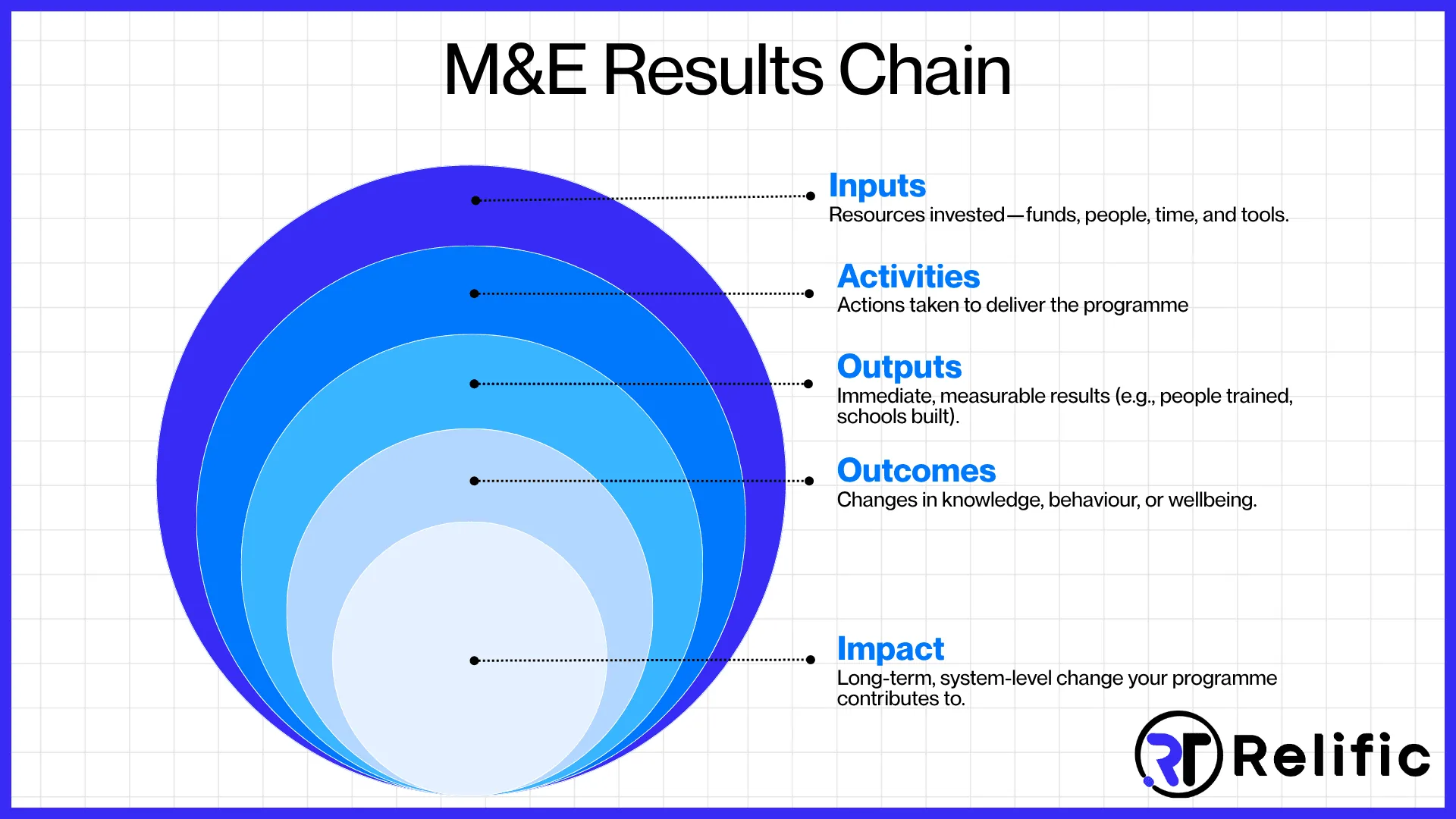
Every serious M&E framework from the W.K. Kellogg Foundation's logic model to the OECD-DAC evaluation criteria describes the same underlying pathway. Resources go in, work happens, products get made, people change, and over time, systems shift. Five links:
Inputs → Activities → Outputs → Outcomes → Impact
The cleanest way to hold this in your head is as a chain of if-then statements, which is exactly how the Kellogg guide frames it: if we have these resources, then we can run these activities; if we run them, then we produce these outputs; if those outputs land, then these outcomes follow; and if outcomes accumulate, then this impact results. If the logic doesn't hold on paper, the programme won't hold in the field. Let's take the links one at a time.
Inputs: What You Invest
Inputs are the resources you commit: money, staff, volunteers, partners, equipment, time, expertise. In a girls' education programme, inputs might be ₹80 lakh, 25 teachers, and 12 learning centres. Inputs are the easiest thing to report and the least meaningful on their own. A budget is a promise, not a result. One of the most common early mistakes in the sector is treating an input as though it were an achievement, reporting the money raised as if raising it were the point.
Activities: What You Do
Activities are the actions you take with those inputs: running training sessions, delivering services, building facilities, holding workshops. The Kellogg guide describes them as the processes, tools, events, and actions that are an intentional part of programme implementation. Activities still sit on the "planned work" side of the chain. They describe effort, not effect.
Outputs: What You Produce
Now it gets interesting, because outputs are where most reporting stops and where most of the confusion lives.
Outputs are the direct, countable products of your activities: the number of people served, sessions delivered, materials distributed, facilities built. The Kellogg Foundation adds a useful lens: outputs tell you whether a programme was delivered to the intended audience at the intended "dose." Did the classes actually run, for the number of children you promised, for the full year?
Examples: 1,200 girls enrolled. 84% average attendance. 50 schools built. 10,000 professionals trained.
Outputs share three defining features, and together they explain both the appeal and the trap. They are countable; you tally them. They are almost entirely within your control: fund the classes and the classes happen. And they are immediate; you can report them the moment the activity ends. That combination is seductive.
Outputs are easy to hit, easy to measure, and easy to mistake for success. But "50 schools built" tells you nothing about whether one child learned to read. An output answers "what did we do?" It is structurally incapable of answering "so what?"
Outcomes: The Change That Follows
Outcomes are the changes in people that result from your outputs: shifts in knowledge, skills, behaviour, attitudes, status, or wellbeing. They are usually expressed qualitatively (improved health, increased financial confidence, higher completion rates), and they are harder to measure than outputs because they unfold over time and require you to compare a "before" with an "after."
Outcomes are conventionally sequenced by horizon, and the Kellogg model puts rough timeframes on them:
- Short-term outcomes (roughly 1–3 years): immediate changes, often in knowledge or attitude. Girls' reading proficiency rises by two grade levels.
- Intermediate outcomes (roughly 4–6 years): changes in behaviour, norms, or practice. Dropout rates fall; parents keep daughters enrolled through secondary school.
- Long-term outcomes: sustained changes in condition or status that begin to shade into impact. More girls complete their education and move into work.
The jump from output to outcome is the single most important line in all of M&E, and it's the one most programmes never cross. It's the move from "620 women attended our financial-literacy workshops" (output) to "620 women now save regularly and operate their own bank accounts" (outcome). The first is attendance. The second is change. And here's the catch that trips up so many well-run programmes: outcomes are influenced, not controlled. You can deliver a flawless workshop and still change nothing, because the people in the room and their circumstances get a vote.
Impact: The Lasting Difference
Impact is the fundamental, long-term change at the level of communities, organisations, or systems that your programme contributes to. The Kellogg Foundation defines it precisely as "the fundamental intended or unintended change occurring in organisations, communities or systems as a result of program activities within 7 to 10 years." Note that the Foundation's own model expects impact to often materialise after the funding has ended.
Three features make impact the hardest of the three to claim honestly. It is population- or system-level, not individual. It routinely includes unintended effects, some of them negative. And it is rarely something you caused alone; you contributed to it alongside government policy, economic conditions, other organisations, and plain luck.
In the education example, impact is what you can read across a whole community over a decade: more girls finishing school, marrying later, earning more, and raising children who themselves stay in school. The operative word is contributes. No single programme owns that shift, and pretending otherwise is exactly where credibility goes to die, which we'll come back to.
Outputs vs Outcomes vs Impact, Side by Side
If you take one sentence from this article, take this one: you count outputs, you measure outcomes, and you argue for impact.
Here's the same distinction laid out for reference:
| Outputs | Outcomes | Impact | |
|---|---|---|---|
| Answers | “What did we deliver?” | “What changed for people?” | “What lasting difference did we make?” |
| Nature | Countable, tangible, direct | Shifts in knowledge, behaviour, status | Population- or system-level change |
| Your control | Almost complete | Influenced, not controlled | Contributed to, rarely solely caused |
| Time horizon | Immediate | Short to medium term (1–6 years) | Long term (7–10 years) |
| Ease of measuring | Easy — just count | Harder — needs baselines and follow-up | Hardest — the attribution problem |
| Example | 1,000 women trained | 620 now use bank accounts | Household financial resilience rises |
| The failure mode | Dismissed as vanity metrics | Skipped because it’s hard | Over-claimed |
Where "Monitoring" and "Evaluation" Actually Fit
People say "M&E" as a single word, but monitoring and evaluation are two distinct cadences reading the same programme, and they live at different ends of the chain.
Monitoring is continuous: It's the routine tracking and reporting of priority information about a programme while it's live, weekly, monthly, quarterly. Its job is course correction: catching a problem early enough to fix it. Monitoring naturally sits at the front of the chain, watching inputs, activities, and outputs. Are the classes running? Is attendance holding? Is the money flowing where it should?
Evaluation is periodic and deeper: It happens at fixed comparison points baseline, endline, follow-up and its job is attribution: establishing that the change is real and working out how much of it your programme is responsible for. Evaluation lives at the deep end of the chain, where outputs turn into outcomes and outcomes into impact.
They're complementary, not interchangeable. Monitoring tells you whether you're on track. Evaluation tells you whether "on track" was even the right track. A programme with strong monitoring but no evaluation knows, with great precision, that it delivered every workshop it promised and never learns whether the workshops worked. In practice, this is the gap that swallows most well-funded programmes: the dashboards are green all year, and then the endline evaluation reveals the intervention moved nothing at all.
The Frameworks That Hold The Chain Together
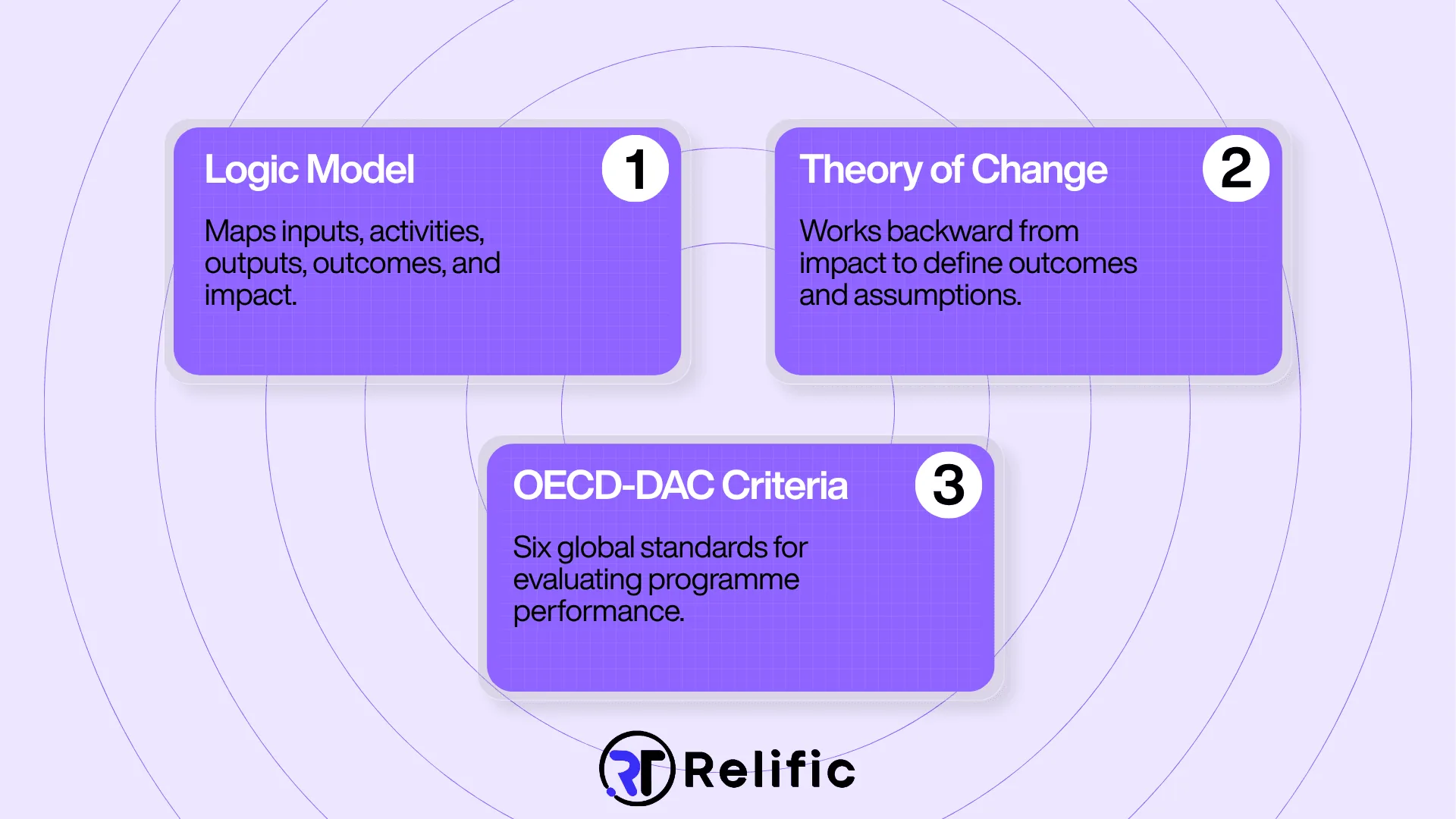
Here's the reassuring part: you don't have to build any of this from scratch. Three frameworks have been refined over decades of field practice, and they work together rather than compete: one to plan, one to test your assumptions, and one to judge the result.
The Logic Model (W.K. Kellogg Foundation)
The logic model is the most widely used planning tool in the sector. It's a single picture of how you believe your programme will work, linking resources, activities, outputs, outcomes, and impact through explicit if-then logic. Its real power is diagnostic: it forces you to state, in advance, which activity is supposed to produce which change and therefore what you'll need to measure to know whether you were right. A logic model that doesn't hold together on the page is a warning worth heeding before a rupee is spent.
Theory of Change
A theory of change works in the opposite direction. You start from the long-term impact you want, then map backwards: the preconditions required to reach it, the outcomes that must occur first, the outputs that produce those outcomes, and the activities that generate them. Where a logic model shows the pipeline, a theory of change makes the assumptions between each link explicit and testable. The two fit together neatly: a theory of change explains why you expect change; the logic model lays out how it flows.
The OECD-DAC Evaluation Criteria
When it's time to judge a programme rather than plan it, the global standard is the OECD Development Assistance Committee's six criteria. They provide a normative framework for determining the merit or worth of an intervention. Originally five, they were revised in December 2019 to add coherence:
| Criterion | The question it asks |
|---|---|
| Relevance | Is the intervention doing the right things, meeting real needs? |
| Coherence | How well does it fit with other efforts and policies? |
| Effectiveness | Is it achieving its objectives and intended outcomes? |
| Efficiency | Are resources being used well? Is the “dose” worth the cost? |
| Impact | What lasting, higher-level difference does it make? |
| Sustainability | Will the benefits last after the funding ends? |
Relific's company benchmarking analysis found that a large majority of CSR funds concentrate in a handful of wealthier states, while tribal belts and Aspirational Districts stay chronically underfunded a distortion that's completely invisible if you only count rupees spent.
The "so what?" Test, Worked Through one Programme
The fastest way to internalise the chain is to read a single programme at five depths, asking "so what?" at each rung. Each answer resolves the question the rung below it leaves hanging.
Input: ₹80 lakh, 25 teachers, 12 learning centres. So what? What did you do with it? Activity: After-school classes run for a full academic year. So what? Did anyone actually benefit? Output: 1,200 girls enrolled, 84% attendance. So what? Did anything change? Outcome: Reading proficiency up two grade levels; dropout down 40%. So what? Does it last? Impact: More girls finish school, marry later, earn more a shift visible across the whole community over a decade.
If your report stops at the output rung, you have documented activity and evidenced nothing. The "so what?" is where impact begins. This is exactly the discipline that separates the sector's leaders: the strongest CSR programmes report verifiable outcomes like "improved employability" rather than inputs like "trained X students," and they publish independent audits, turning transparency into a competitive advantage. The lesson compresses to a single line: "built 50 schools" is an output; "improved reading proficiency by two grade levels" is an outcome, and regulators, boards, and funders can now tell the two apart.
The Hardest Problem: Attribution vs Contribution
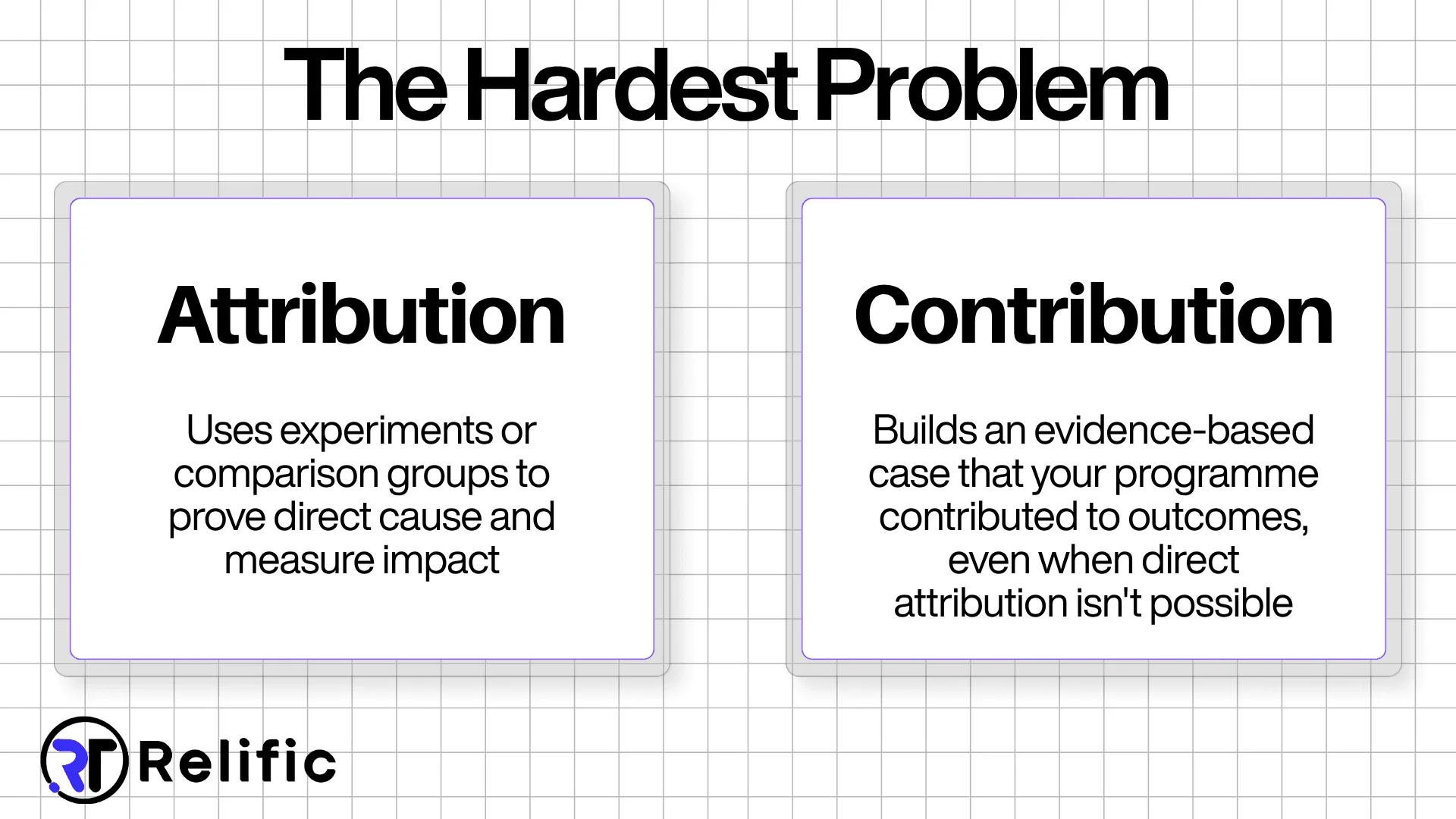
Here's where impact measurement gets genuinely difficult, and where most over-claiming happens. The moment you start measuring outcomes and impact, you run into a brutal question: how do you know your programme caused the change, and not something else entirely?
There are two honest answers, and choosing the right one is a craft in itself.
Attribution establishes a direct causal link using experimental or quasi-experimental designs: randomised controlled trials, difference-in-differences, regression discontinuity. It produces an effect size backed by a counterfactual: evidence of what would have happened anyway, without your programme. Attribution is the gold standard for bounded interventions with clear outcomes and a clean comparison group. But it breaks down when budget, timeline, or ethics make experimental design infeasible, which describes the overwhelming majority of real-world social programmes. You often cannot, and should not, withhold a service from a control community for years to prove a point.
Contribution analysis, developed by the evaluator John Mayne in 2001, is the answer for complex, multi-actor settings. Rather than claiming a percentage of the credit, it builds a defensible causal story. It starts from an honest premise: change at the level of outcomes and impacts happens because of a combination of factors (a "causal package") in which your intervention is one contributor, not the sole cause.
Instead of asking "did we cause it?" it asks the more answerable "is it reasonable to conclude we contributed, and how?" Mayne's method runs through six iterative steps: set out the attribution problem, develop the theory of change, gather evidence on it, assemble a contribution narrative, seek more evidence where there are gaps, and revise the narrative until a plausible, evidence-based account emerges. The output is not a number. It's a credible, tested story about how your intervention moved the needle inside a messy web of causes.
The practical takeaway is simple, and it's the whole ethic of honest reporting: most social programmes contribute to change; they rarely cause it single-handedly. Credible reporting claims contribution and proves it, rather than over-claiming attribution it can't defend. As Relific frames it in its SROI work, a story without data is memorable but not defensible, and data without a defensible causal story is just a pile of numbers.
Putting a Value on Outcomes: SROI
When you need to translate outcomes into a language a CFO or a board will act on, Social Return on Investment (SROI) is the bridge. SROI assigns a monetary value to social outcomes and expresses it as a ratio; a result of 4:1 means every ₹1 invested created ₹4 of social value. What makes credible SROI valuable, rather than a marketing number, is that it forces you to confront the attribution problem head-on.
Governed by Social Value International principles, a proper SROI adjusts for deadweight (what would have happened anyway), attribution (the share of the change driven by others), and drop-off (how benefits fade over time). Skip those adjustments, and you manufacture "impact washing", an inflated ratio that collapses the moment it meets an auditor. Done properly, SROI is one of the few tools that reliably converts an outcome into something a finance function will actually act on, which is why SEBI's BRSR Core push toward assured social metrics has made it more relevant, not less.
The India Context: From Spend to Proof
For Indian organisations, the shift from output-counting to outcome-ownership is not a philosophical preference. It's the direction the regulation is already travelling.
The signals line up. India now has tens of thousands of companies collectively spending more than ₹40,000 crore a year on CSR a scale that makes independent verification a national priority rather than a nicety. The mandatory impact assessment rule means outcomes are, in effect, a legal requirement for larger programmes: if you clear the ₹10 crore obligation threshold, your ₹1 crore-plus projects have to be independently assessed. And SEBI's BRSR framework is dissolving the old wall between CSR data and ESG data into a single, audited system, which means the same evidence standard now applies whether a stakeholder is reading your sustainability report or your annual report.
Spreadsheets can record activity. What they cannot do is prove outcomes, satisfy Section 135 and BRSR obligations simultaneously, or scale cleanly across dozens of partners and multiple states. As Relific argues in its guide to choosing CSR software, India's regulatory direction rewards verified outcomes over spend totals, which raises the premium on clean, traceable, well-structured data. The organisations that will thrive in this environment are the ones that engineered their measurement from the start, applying the same rigour to their social programmes that they apply to their core business.
This is also, not coincidentally, why strategic CSR outperforms cheque-book philanthropy. Consider a bank: writing a cheque to a random NGO produces an output (money disbursed) and stops there. Training village women in financial literacy produces measurable outcomes: women who save, borrow responsibly, and build assets. And as a second-order effect, it produces real business value too, in the form of a wider customer base and lower credit risk. Aligning your outcomes with your own capabilities, as Relific lays out in its CSR strategy guide, is how impact becomes both genuine and self-sustaining.
Common Mistakes, and How to Avoid Them
A practical checklist drawn from everything above:
Reporting outputs as if they were impact: "We trained 10,000 people" is an output. Keep asking "so what?" until you reach a genuine change in people's lives, and if you can't get there, you haven't found your outcome yet.
Skipping outcomes because they're hard: Outcomes need baselines and follow-up, which is real work. Skip them, and you have no evidence anything worked; you've only documented that you were busy.
Over-claiming attribution: If you didn't run a counterfactual, don't claim you single-handedly caused the change. Use contribution analysis and make an honest, defensible case instead.
No baseline: You cannot measure change without a "before." Capture baseline data before the intervention starts; retrofitting it afterwards is guesswork wearing a lab coat.
Confusing monitoring with evaluation: Monitoring keeps you on track; evaluation tells you whether the track was right. You need both, running at different cadences.
Leaning on vanity metrics: Hours volunteered and rupees donated feel impressive and signify little. Boards have learned to discount them, so lead with something sturdier.
Ignoring unintended effects: Real impact includes the consequences you didn't plan for, some of them negative. Look for them, and report them; honest evaluation names its own side effects.
Only measuring totals: Aggregate success can conceal who was left out. Disaggregate your outcome data by group and by geography, or you'll miss the exclusion hiding inside your average.
From Measuring Impact to Delivering It: Where Relific Fits

Relific is an AI-powered social impact platform designed to help organisations move from output-counting to outcome-ownership. Generic project tools like Asana, Trello, or a stack of spreadsheets track tasks and deadlines, but they were never built for social impact: no grant lifecycle, no SDG or Schedule VII mapping, no outcome reporting.
Relific absorbs that complexity instead, capturing good data once, tagging it to the right frameworks, and making impact visible to the regulators, auditors, and stakeholders who now expect proof rather than promises. The efficiency gain is not trivial: AI-driven platforms have compressed impact reporting timelines from months to weeks, turning measurement from a year-end scramble into a live capability you can actually steer with.
The Bottom Line
Outputs, outcomes, and impact are not synonyms. They are three sequential answers to three increasingly hard questions. Outputs tell you what you did. Outcomes tell you what changed. Impact tells you what lasting difference you made. Move down that chain and your control falls, the difficulty rises, and the value of the change grows.
The organisations losing credibility right now are the ones still reporting outputs while calling it impact. The ones earning trust and, in India, staying ahead of Section 135 and BRSR are those that have crossed the line from counting activity to evidencing change. That crossing is the discipline of monitoring and evaluation. Get the vocabulary right, map your logic, choose attribution or contribution honestly, and measure what actually matters.
Because in the boardrooms where that new silence has started to appear, only one kind of answer still lands. Not "here's what we spent," but "here's what changed and here's the evidence."
Frequently Asked Questions
Not quite. Outcomes are changes in your programme's participants' knowledge, behaviour, or status. Impact is the broader, longer-term change at the level of communities or systems, including effects you didn't intend and change you contributed to alongside many other forces. Impact is wider in scope, longer in horizon (the Kellogg model puts it at 7–10 years), and much harder to attribute to you alone.
Yes, depending on your programme's logic. A trained health worker is an output of a training programme, but could be an input to a downstream health programme. The labels describe a position in your results chain, not a fixed property of the thing itself, which is exactly why mapping your own logic model matters before you start measuring.
All three, at the right cadence. Monitor outputs continuously to stay on track. Evaluate outcomes at baseline, endline, and follow-up to prove change happened. Assess impact over the long term, and frame it honestly as contribution. Don't skip outcomes just because outputs are easier to count or impact sounds more impressive.
An activity is what you do (run a workshop). An output is what that activity produces (participants trained, materials distributed). Activities describe effort; outputs are the countable results of that effort.
No. RCTs deliver strong attribution but are frequently infeasible on grounds of cost, time, or ethics. Contribution analysis, developed by John Mayne, offers a rigorous, theory-based alternative that produces a defensible causal narrative rather than an effect size, and it's well suited to the complex, multi-actor social programmes where withholding a service from a control group would be neither practical nor right.
An output is what an activity produces, for example, 1,200 students trained. An outcome is the change that results from that output, for example, 620 of those students now demonstrate improved employability. In CSR reporting, regulators and boards increasingly expect outcomes, not just outputs, because outputs prove activity while outcomes prove change.
Yes. Under Rule 8(3) of the Companies CSR Policy Rules, companies with an average CSR obligation of ₹10 crore or more over the preceding three financial years must commission an independent impact assessment for any project with an outlay of ₹1 crore or more that has run for at least a year.
The results chain is the five-step logic that underlies most M&E frameworks: Inputs → Activities → Outputs → Outcomes → Impact. Each link is connected by an if-then assumption: if these resources are used for these activities, they produce these outputs, which lead to these outcomes, which accumulate into impact.
Outcomes matter more because they show whether a programme actually changed something for people, while outputs only show that activity occurred. Boards and regulators (including under India's Rule 8(3) impact assessment mandate) increasingly treat output-only reporting as insufficient evidence of real social return.